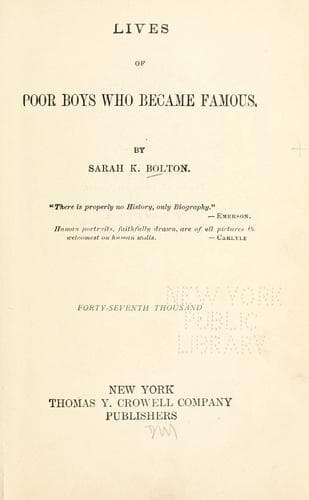
Lives of Poor Boys Who Became FamousBolton, Sarah Knowles
History
Lives of Poor Boys Who Became Famous
Bolton, Sarah Knowles
Biography
All this time he was working very hard. He said, "I must correspond with
the directors of the theatres; must obtain information regarding the
people with whom I am to deal; I must make my appointments for concerts
and rehearsals; have my music copied, correct the scores, compose, play,
travel nights. I am always cheated, and in everlasting trouble. I
reproach myself when everything does not turn out for the best, and am
consumed with grief. I really believe I should succumb to all these
demands and fatigues if it were not for my drinking cold water, and
bathing in it every morning and evening."
In November, 1843, urged by Fanny Elssler, he visited America. At
first, in New York, some of the prominent violinists opposed him; but he
steadily made his way. When Mr. James Gordon Bennett offered him the
columns of the "Herald," that he might reply to those who were assailing
him, he said in his broken English, "I tink, Mr. Bennett, it is best tey
writes against me, and I plays against tem." Of his playing in New York,
Mrs. Lydia Maria Child wrote, "His bow touched the strings as if in
sport, and brought forth light leaps of sound, with electric rapidity,
yet clear in their distinctness. He played on four strings at once, and
produced the rich harmony of four instruments. While he was playing, the
rustling of a leaf might have been heard; and when he closed, the
tremendous bursts of applause told how the hearts of thousands leaped
like one. His first audience were beside themselves with delight, and
the orchestra threw down their instruments in ecstatic wonder."
From New York he took a successful trip South. That he was not
effeminate while deeply poetic, a single incident will show. After a
concert, a man came to him and said he wished the diamond in his violin
bow, given him by the Duke of Devonshire. Ole Bull replied that as it
was a gift, he could neither sell it nor give it away.
"But I am going to have that stone!" said the man as he drew a bowie
knife from his coat. In an instant Ole Bull had felled the man to the
floor with the edge of his hand across his throat. "The next time I
would kill you," said the musician, with his foot on the man's chest;
"but you may go now." So much did the ruffian admire the muscle and
skill of the artist, that he begged him to accept the knife which he had
intended to use upon him.
Public-domain text, read in full here on John Shaqi.
Reviews
Reviews
No reviews yet
Be the first to share your thoughts on this work.
Elsewhere in the archive
Join the Discussion
Join the discussion
Sign in to leave a comment or review.
Sign InorCreate an account