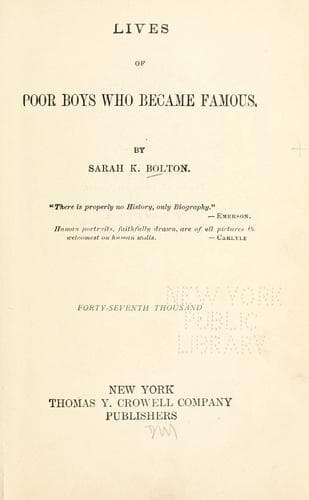
Lives of Poor Boys Who Became FamousBolton, Sarah Knowles
History
Lives of Poor Boys Who Became Famous
Bolton, Sarah Knowles
Biography
In 1855 he received the grand medal; in 1856 he was made an officer of
the Legion of Honor; in 1861, a member of the Institute; and in 1867,
at the International Exhibition, he received the grand medal again. When
the prizes were given by the Emperor, the "Battle of Solferino" was
placed in the centre of the space cleared for the ceremony, with the
works of Reimers, the Russian painter, Knaus of Prussia, Rousseau, the
French landscape-painter, and others. This painting represents Napoleon
III. in front of his staff, looking upon the battle "as a cool player
studies a chess-board. On the right, in the foreground, some
artillery-men are manoeuvring their guns. The corpses of a French
soldier and two white Austrians, torn to rags by some explosion, show
where the battle had passed by."
Meissonier's paintings now brought enormous prices. His "Marshal Saxe
and his Staff" brought eight thousand six hundred dollars in New York;
the "Soldiers at Cards," in 1876, in the same city, eleven thousand five
hundred dollars; in 1867, his "Cavalry Charge" was sold to Mr. Probasco
of Cincinnati, for thirty thousand dollars; and the "Battle of
Friedland," upon which he is said to have worked fifteen years, to A. T.
Stewart, of New York, for sixty thousand dollars. Every figure in this
was drawn from life, and the horses moulded in wax. It represents
Napoleon on horseback, on a slight elevation, his marshals grouped
around him, holding aloft his cocked hat in salutation, as the soldiers
pass hurriedly before him.
Edmund About once wrote, "To cover M. Meissonier's pictures with gold
pieces simply would be to buy them for nothing; and the practice has now
been established of covering them with bank notes."
"The Blacksmith," shoeing a patient old cart-horse, perfect in anatomy;
"La Halte," some soldiers at an inn, now in Hertford House gallery; and
"La Barricade," a souvenir of the civil war, are among the favorite
pictures of this famous man. And yet as one looks at some of the
exquisite work about a convivial scene, the words of the great Boston
painter, William Hunt, come to mind. Being shown a picture, very fine in
technique, by a Munich artist, of a drunken man, holding a half-filled
glass of wine, he said, "It's skilfully done, but _what is_ the _use_ of
_doing_ it! The subject isn't worthy of the painter."
Rarely does a woman appear in Meissonier's pictures. He has done nothing
to deprave morals, which is more than can be said of some French art.
His portrait of Madame Henri Thenard was greatly admired, while that of
Mrs. Mackay was not satisfactory, and was said to have been destroyed by
her. Few persons, however, can afford to destroy a Meissonier. When told
once that "he was a fortunate man, as he could possess as many
Meissoniers as he pleased," he replied, "No, no, I cannot; that would
ruin me. They are a great deal too dear."
Public-domain text, read in full here on John Shaqi.
Reviews
Reviews
No reviews yet
Be the first to share your thoughts on this work.
Elsewhere in the archive
Join the Discussion
Join the discussion
Sign in to leave a comment or review.
Sign InorCreate an account