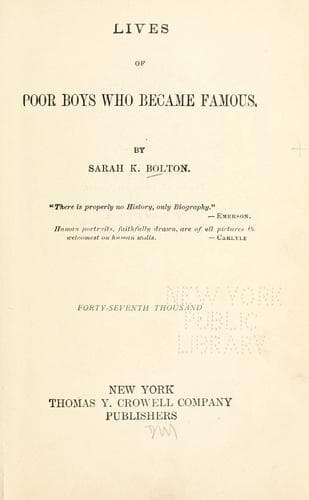
Lives of Poor Boys Who Became FamousBolton, Sarah Knowles
History
Lives of Poor Boys Who Became Famous
Bolton, Sarah Knowles
Biography
Near by are his well-filled stables, his favorite horse, Rivoli, being
often used for his model. He is equally fond of dogs, and has several
expensive hounds. How strange all this, compared with those early days
of pinching poverty! He is rarely seen in public, because he has
learned--what, alas! some people learn too late in life--that there is
no success without one commands his or her time. It must be frittered
away neither by calls nor parties; neither by idle talk nor useless
visits. Painting or writing for an hour a day never made greatness. Art
and literature will give no masterships except to devotees. The young
lady, sauntering down town to look at ribbons, never makes a George
Eliot. The young man, sauntering down town to look at the buyers of
ribbons, never makes a Meissonier. Nature is rigid in her laws. Her
gifts only grow to fruitage in the hands of workers.
Meissonier is now seventy-four, with long gray beard and hair, round,
full face, and bright hazel eyes. His friend, Claretie, says of him,
"This man, who lives in a palace, is as moderate as a soldier on the
march. This artist, whose canvases are valued by the half-million, is as
generous as a nabob. He will give to a charity sale a picture worth the
price of a house. Praised as he is by all, he has less conceit in his
nature than a wholesale painter."
* * * * *
January 31, 1891, at his home in Paris, the great artist passed away.
His illness was very brief. The funeral services took place at the
Church of the Madeleine, which was thronged with the leaders of art and
letters. An imposing military cortege accompanied the body to its last
resting-place at Poissy, the summer home of the artist, on the Seine,
ten miles from Versailles.
[Illustration: GEORGE WILLIAM CHILDS.]
GEORGE W. CHILDS.
The "Public Ledger" of Philadelphia, and its owner, are known the world
over. Would we see the large-hearted, hospitable millionaire, who has
come to honor through his own industry, let us enter the elegant
building occupied by his newspaper.
Every portion is interesting. The rooms where editors and assistants
work are large, light, and airy, and as tasteful as parlors. Alas! how
unhomelike and barren are some of the newspaper offices, where gifted
men toil from morning till night, with little time for sleep, and still
less for recreation. Mr. Childs has thought of the comfort and health of
his workmen, for he, too, was a poor boy, and knows what it is to labor.
Public-domain text, read in full here on John Shaqi.
Reviews
Reviews
No reviews yet
Be the first to share your thoughts on this work.
Elsewhere in the archive
Join the Discussion
Join the discussion
Sign in to leave a comment or review.
Sign InorCreate an account