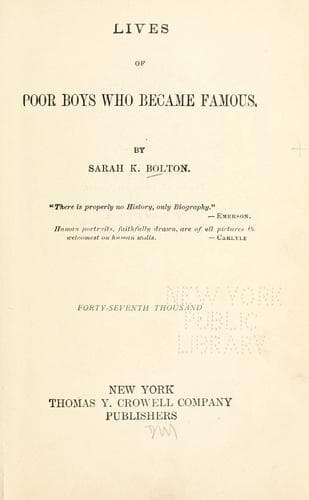
Lives of Poor Boys Who Became FamousBolton, Sarah Knowles
History
Lives of Poor Boys Who Became Famous
Bolton, Sarah Knowles
Biography
His library is one of the most charming places in this country. The
wood-work is carved ebony with gold, the bookshelves six feet high on
every side, and the ceiling built in sunken panels, blue and gold. In
the centre is a table made from ebony, brought from Africa by Paul du
Chaillu. One looks with interest upon the handsome volumes of the
standard authors, but other things are of deeper interest.
Here is an original sermon of Rev. Cotton Mather; the poems of Leigh
Hunt, which he presented to Charles Dickens; the original manuscript of
Nathaniel Hawthorne's "Consular Experiences"; the first edition of the
"Scarlet Letter," with a note to Mr. Childs from the great novelist;
Bryant's manuscript of the "First Book of the Iliad"; James Russell
Lowell's "June Idyl," begun in 1850 and finished eighteen years
afterward; the manuscript of James Fenimore Cooper's "Life of Captain
Richard Somers"; and Edgar Allan Poe's "Murders in the Rue Morgue,"
seventeen pages of large paper written small and close.
Here is an autograph letter from Poe, in which he offers to his
publishers thirty-three short stories, enough to fill two large volumes,
"On the terms which you allowed me before; that is, you receive all
profits and allow me twenty copies for distribution to friends." From
this it seems that Poe had the _usual_ struggles of literary people.
One of the most unique things of the library is the manuscript of "Our
Mutual Friend," bound in fine brown morocco. The skeleton of the novel
is written through several pages, showing how carefully Dickens thought
out his plan and his characters; the paper is light blue, written over
with dark blue ink, with many erasures and changes. Here are also
fifty-six volumes of Dickens' works, with an autograph letter in each,
from the author to Mr. Childs. Here is Lord Byron's desk on which he
wrote "Don Juan." Now we look upon the smallest book ever printed,
Dante's "Divina Commedia," bound in Turkey gilt, less than two and
one-fourth inches long by one and one-half inches wide.
The collection of Mr. and Mrs. S. C. Hall, now the property of Mr.
Childs, letters and manuscripts from Lamb, Hawthorne, Mary Somerville,
Harriet Martineau, Coleridge, Wordsworth, Browning, and hundreds of
others, is of almost priceless value. In 1879 Mrs. Hall gave the Bible
of Tom Moore to Mr. Childs, "an honored and much loved citizen of the
United States, as the best and most valuable offering she could make to
him, as a grateful tribute of respect, regard, and esteem."
Another valuable book is made up of the portraits of the presidents,
with an autograph letter from each. Dom Pedro of Brazil sent, in 1876, a
work on his empire, with his picture and his autograph. George Peabody
sat for a full-length portrait for Mr. Childs. The album of Mrs. Childs
contains the autographs of a great number of the leading men and women
of the world.
Public-domain text, read in full here on John Shaqi.
Reviews
Reviews
No reviews yet
Be the first to share your thoughts on this work.
Elsewhere in the archive
Join the Discussion
Join the discussion
Sign in to leave a comment or review.
Sign InorCreate an account