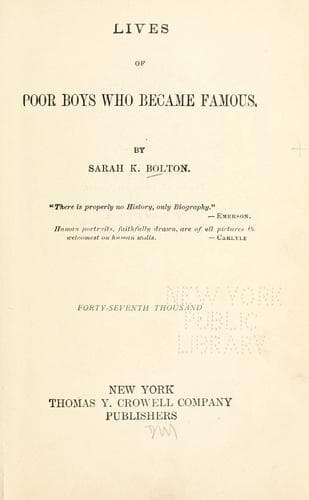
Lives of Poor Boys Who Became FamousBolton, Sarah Knowles
History
Lives of Poor Boys Who Became Famous
Bolton, Sarah Knowles
Biography
This was said to Dr. Magoun, President of Iowa College, and myself,
after we had waited for nearly an hour, outside of Spurgeon's
Tabernacle, in London, in the hope of hearing Mr. Moody preach. Finally,
probably through courtesy to Americans, we obtained seats. The six
thousand in this great church were sitting as though spellbound. The
speaker was a man in middle life, rugged, strong, and plain in dress and
manner. His words were so simple that a child could understand them. Now
tears came into the eyes of most of the audience, as he told some
touching incident, and now faces grew sober as the people examined their
own hearts under the searching words. There was no consciousness about
the preacher; no wild gesture nor loud tone. Only one expression seemed
applicable, "a man dead in earnest."
And who was this man whom thousands came to hear? Not a learned man,
not a rich man, but one of the greatest evangelists the world has ever
seen. Circumstances were all against him, but he conquered
circumstances.
Dwight Lyman Moody was born at Northfield, Mass., Feb. 5, 1837. His
father, a stone-mason and farmer, died when the boy was four years old,
broken down with reverses in business. His mother was left with seven
sons and two daughters, the eldest a boy only fifteen. What happened to
this lad was well told by Mr. Moody, a few years since. "Soon after my
father's death the creditors came in and took everything. One calamity
after another swept over the entire household. Twins were added to the
family, and my mother was taken sick. To the eldest boy my mother looked
as a stay in her calamity; but all at once that boy became a wanderer.
He had been reading some of the trashy novels, and the belief had seized
him that he had only to go away, to make a fortune. Away he went. I can
remember how eagerly she used to look for tidings of that boy; how she
used to send us to the post-office to see if there was a letter from
him, and recollect how we used to come back with the sad news, 'No
letter!' I remember how in the evenings we used to sit beside her in
that New England home, and we would talk about our father; but the
moment the name of that boy was mentioned she would hush us into
silence. Some nights, when the wind was very high, and the house, which
was upon a hill, would tremble at every gust, the voice of my mother was
raised in prayer for that wanderer, who had treated her so unkindly. I
used to think she loved him better than all of us put together, and I
believe she did.
Public-domain text, read in full here on John Shaqi.
Reviews
Reviews
No reviews yet
Be the first to share your thoughts on this work.
Elsewhere in the archive
Join the Discussion
Join the discussion
Sign in to leave a comment or review.
Sign InorCreate an account