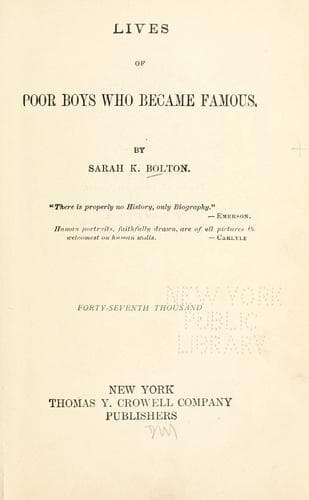
Lives of Poor Boys Who Became FamousBolton, Sarah Knowles
History
Lives of Poor Boys Who Became Famous
Bolton, Sarah Knowles
Biography
One day a man on trial for murder had secured the able lawyer, John A.
Breckenridge, to defend him. Abraham listened as he made his appeal to
the jury. He had never heard anything so eloquent. When the court
adjourned the tall, homely boy, his face beaming with admiration for the
great man, pressed forward to grasp his hand; but, with a contemptuous
air, the lawyer passed on without speaking. Thirty years later the two
met in Washington, when Abraham Lincoln was the President of the United
States; and then he thanked Mr. Breckenridge for his great speech in
Indiana.
In March, 1828, the long-hoped-for opportunity to see the world outside
of Gentryville had come. Abraham was asked by a man who knew his honesty
and willingness to work, to take a flat-boat down the Mississippi River
to New Orleans. He was paid only two dollars a week and his rations; and
as a flat-boat could not come up the river, but must be sold for lumber
at the journey's end, he was obliged to walk the whole distance back.
The big-hearted, broad-shouldered youth, six feet and four inches tall,
had seen in this trip what he would never forget; had seen black men in
chains, and men and women sold like sheep in the slave-marts of New
Orleans. Here began his horror of human slavery, which years after
culminated in the Emancipation Proclamation.
Two years later, when he had become of age, Abraham helped move his
father's family to Illinois, driving the four yoke of oxen which drew
the household goods over the muddy roads and through the creeks. Then he
joined his adopted brothers in building a log house, plowed fifteen
acres of prairie land for corn, split rails to fence it in, and then
went out into the world to earn for himself, his scanty wages heretofore
belonging legally to his father. He did not always receive money for his
work, for once, for a Mrs. Miller, he split four hundred rails for every
yard of brown jeans, dyed with white walnut bark, necessary to make a
pair of trowsers.
He had no trade, and no money, and must do whatever came to hand. For a
year he worked for one farmer and another, and then he and his
half-brother were hired by a Mr. Offutt to build and take a flat-boat to
New Orleans. So pleased was the owner, that on Abraham's return, he was
at once engaged to manage a mill and store at New Salem. Here he went by
the name of "Honest Abe," because he was so fair in his dealings. On one
occasion, having sold a woman a bill of goods amounting to two dollars
and six and a quarter cents, he found that in adding the items, he had
taken six and a quarter cents too much. It was night, and locking the
store, he walked two or three miles to return the money to his
astonished customer. Another time a woman bought a half pound of tea. He
discovered afterward that he had used a four-ounce weight on the scales,
and at once walked a long way to deliver the four ounces which were her
due. No wonder the world, like Diogenes, is always looking for an honest
man.
Public-domain text, read in full here on John Shaqi.
Reviews
Reviews
No reviews yet
Be the first to share your thoughts on this work.
Elsewhere in the archive
Join the Discussion
Join the discussion
Sign in to leave a comment or review.
Sign InorCreate an account