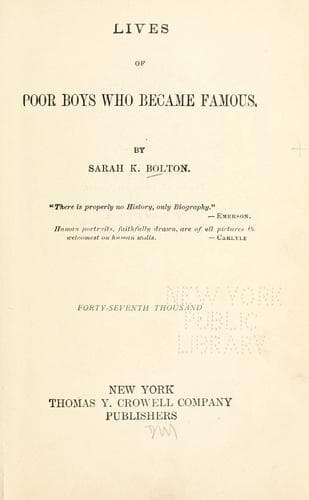
Lives of Poor Boys Who Became FamousBolton, Sarah Knowles
History
Lives of Poor Boys Who Became Famous
Bolton, Sarah Knowles
Biography
When he was forty, he published the "Vanity of Human Wishes," receiving
seventy-five dollars, asserted by many to be the most impressive thing
of its kind in the language. The lines,
"There mark what ills the scholar's life assail,
Toil, envy, want, the patron, and the jail,"
show his struggles. A drama soon after, played by the great actor, David
Garrick, brought him nearly a thousand dollars; but the play itself was
a failure. When asked by his friends how he felt about his ill success,
he replied, "Like the monument," meaning that he continued firm and
unmoved, like a column of granite. Fame was coming at last, after he had
struggled in London for thirteen years--and what bitterness they had
brought!
For two years he worked almost constantly on a paper called the
"Rambler." When his wife said that, well as she had thought of him
before, she had never considered him equal to this, he was more pleased
than with any praise he ever received. She died three days after the
last copy was published, and Johnson was utterly prostrated. He buried
himself in hard work in his garret, a most inconvenient room; but he
said, "In that room I never saw Mrs. Johnson." Her wedding-ring was
placed in a little box, and tenderly kept till his death.
Three years afterward, his great work, his Dictionary, appeared, for
which he received eight thousand dollars; but, as he had been obliged to
employ six assistants for seven years, he was still poor, but now
famous. The Universities of Oxford and Dublin, when he no longer needed
their assistance, hastened to bestow their degrees upon him. Even George
III. invited him to the royal palace,--a strange contrast to a few years
before, when Samuel Johnson was under arrest for a debt of thirty
dollars! When asked by Reynolds how he had obtained his accuracy and
flow of language in conversation, he replied, "By trying to do my best
on every occasion and in every company." About this time his aged mother
died, and in the evenings of one week, to defray her funeral expenses,
he wrote "Rasselas," and received five hundred dollars for it. He wrote
in his last letter to her, "You have been the best mother, and I believe
the best woman, in the world. I thank you for your indulgence to me, and
beg forgiveness of all that I have done ill, and of all that I have
omitted to do well." His last great work was "The Lives of the Poets."
Public-domain text, read in full here on John Shaqi.
Reviews
Reviews
No reviews yet
Be the first to share your thoughts on this work.
Join the Discussion
Join the discussion
Sign in to leave a comment or review.
Sign InorCreate an account