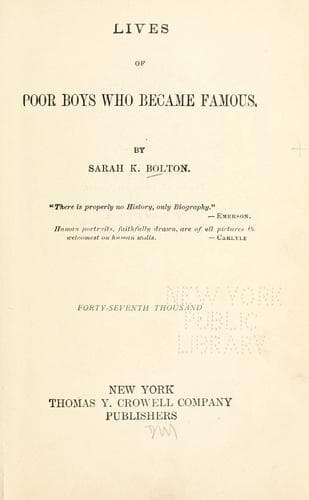
Lives of Poor Boys Who Became FamousBolton, Sarah Knowles
History
Lives of Poor Boys Who Became Famous
Bolton, Sarah Knowles
Biography
He received now a pension of fifteen hundred dollars a year, for his
valuable services to literature, but never used more than four hundred
dollars for himself. He took care of a blind woman of whom he said, "She
was a friend to my poor wife, and was in the house when she died, she
has remained in it ever since," of a mother and daughter dependent upon
an old family physician, and of two men whom nobody else would care for.
Once when he found a poor woman on the street late at night, he took her
home, and kept her till she was restored to health. His pockets were
always filled with pennies for street Arabs; and, if he found poor
children asleep on a threshold, he would slip money into their hands
that, when they awakened, they might buy a breakfast. When a servant was
dying who had been in the family for forty-three years, he prayed with
her and kissed her, the tears falling down his cheeks. He wrote in his
diary, "We kissed and parted--I humbly hope to meet again, and part no
more." He held, rightly, that Christianity levels all distinctions of
rank.
He was very tender to animals. Once, when in Wales, a gardener brought
into the house a hare which had been caught in the potatoes, and was
told to give it to the cook. Dr. Johnson asked to have it placed in his
arms; then, taking it to the window, he let it go, shouting to it to
run as fast as possible. He would buy oysters for his cat, Hodge, that
the servants, from seeing his fondness for it, might be led to treat it
kindly.
He died at the age of seventy-five, such men as Burke and Reynolds
standing by his bedside. Of the latter, he begged that he would "read
his Bible, and never paint on Sundays." His last words were to a young
lady who had asked his blessing: "God bless you, my dear!" He was buried
with appropriate honors in Westminster Abbey, and monuments are erected
to him in St. Paul's Cathedral, and at Lichfield. The poor boy, nearly
blind, became "the brightest ornament of the eighteenth century."
OLIVER GOLDSMITH.
On a low slab in a quiet spot, just north of the Church of Knight
Templars, in London, are the simple words, "Here lies Oliver Goldsmith."
The author of the "Vicar of Wakefield" needs no grander monument; for he
lives in the hearts of the people.
Public-domain text, read in full here on John Shaqi.
Reviews
Reviews
No reviews yet
Be the first to share your thoughts on this work.
Join the Discussion
Join the discussion
Sign in to leave a comment or review.
Sign InorCreate an account