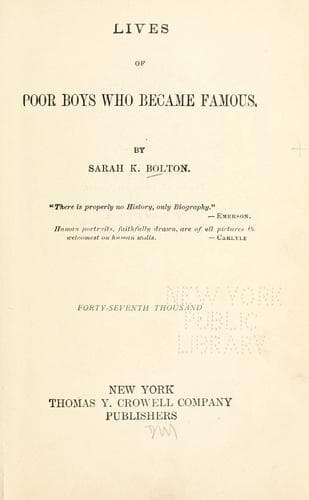
Lives of Poor Boys Who Became FamousBolton, Sarah Knowles
History
Lives of Poor Boys Who Became Famous
Bolton, Sarah Knowles
Biography
Soon after he made another great discovery, that of electric induction,
or that one electric current will induce another current in an adjoining
wire. Others had suspected this, but had sought in vain to prove it. The
Bell telephone, which Sir William Thompson calls "the wonder of
wonders," depends upon this principle. Here no battery is required; for
the vibration of a thin iron plate is made to generate the currents.
After this, Faraday proved that the various kinds of electricity are
identical; and that the electricity of the Voltaic pile is produced by
chemical action, and not by contact of metals, as Volta had supposed.
The world meantime had showered honors upon the great scientist. Great
Britain had made him her idol. The Cambridge Philosophical Society, the
Institution of Civil Engineers, of British Architects, of Philosophy and
of Medicine, and the leading associations of Scotland had made him an
honorary member. Paris had elected him corresponding member of all her
great societies. St. Petersburg, Copenhagen, Stockholm, Berlin, Palermo,
Modena, Lisbon, Heidelberg, Frankfort, and our own Boston and
Philadelphia had sent tokens of admiration. Eminent men from all the
world came to see him.
How proud his mother must have felt at this wonderful success! She was
not able to enter into her son's pursuits from lack of early education;
but she talked much about him, calling him ever, "my Michael"; and would
do nothing whatever without his advice. He supported her in her
declining years; and she seemed perfectly happy. His father had died in
his boyhood; but Faraday ever honored his occupation. He used to say, "I
love a smith-shop, and anything relating to smithing. My father was a
blacksmith."
He was now forty-nine. The overtaxed brain refused to work longer.
Memory was losing her grasp, and but for the sweet and careful presence
of Sarah Faraday, the life-work would doubtless have been finished at
this time. She took him to Switzerland, where he walked beside the lakes
and over the mountains with "my companion, dear wife, and partner in
all things." For four years he made scarcely any experiments in original
research, and then the tired brain seemed to regain its wonted power,
and go on to other discoveries.
An Italian philosopher, Morichini, was the first to announce the
magnetizing power of the solar rays. Mrs. Somerville covered one-half of
a sewing-needle with paper, and exposed the other half to the violet
rays. In two hours the exposed end had acquired magnetism. Faraday, by
long and difficult experiments, showed the converse of this: he
magnetized a ray of light,--an experiment "high, beautiful, and alone,"
says Mr. Tyndall. He also showed the magnetic condition of all matter.
Public-domain text, read in full here on John Shaqi.
Reviews
Reviews
No reviews yet
Be the first to share your thoughts on this work.
Elsewhere in the archive
Join the Discussion
Join the discussion
Sign in to leave a comment or review.
Sign InorCreate an account