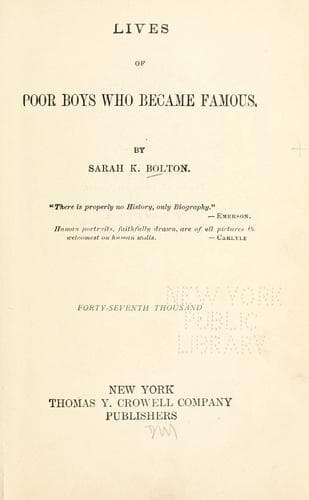
Lives of Poor Boys Who Became FamousBolton, Sarah Knowles
History
Lives of Poor Boys Who Became Famous
Bolton, Sarah Knowles
Biography
A friend, assured of his success, put fifty thousand dollars into the
business. Immediately Bessemer made plans of all the machinery required,
sent various parts to as many different establishments, lest his secret
be found out, and then put the pieces of his self-acting machines
together. Five assistants were engaged at high wages, under pledge of
secrecy. At first he made one thousand per cent profit; and now, in
these later years, the profit is three hundred per cent. Three of the
assistants have died; and Mr. Bessemer has turned over the business and
the factory to the other two. The secret of making the bronze powder has
never been told. Even Mr. Bessemer's oldest son had reached manhood
before he ever entered the locked room where it was made.
For ten years the inventor now turned his attention to the construction
of railway carriages, centrifugal pumps, etc. His busy brain could not
rest. When frequent explosions in coal-mines occasioned discussion
throughout the country, he made, at large expense, a working model for
ventilating mines, and offered to explain it to a committee of the House
of Commons. His offer was declined with thanks. A little investigation
on the part of great statesmen would have been scarcely out of place.
At the great exhibition in London in 1851, he exhibited several
machines,--one for grinding and polishing plate glass, and another for
draining, in an hour, an acre of land covered with water a foot deep.
The crowd looked at them, called the inventor "the ingenious Mr.
Bessemer," and passed on. Two years later he made some improvements in
war implements, and submitted his plans to the Woolwich Arsenal; but
they were declined, without thanks even. Some other men might have
become discouraged; but Mr. Bessemer knew that obstacles only strengthen
and develop men.
The improved ordnance having been brought to the knowledge of Napoleon
III., he encouraged the inventor, and furnished the money to carry
forward the experiments. While the guns were being tested at Vincennes,
an officer remarked, "If you cannot get stronger metal for your guns,
such heavy projectiles will be of little use." And then Mr. Bessemer
began to ask himself if he could not improve iron. But he had never
studied metallurgy. This, however, did not deter him; for he immediately
obtained the best books on the subject, and visited the iron-making
districts. Then he bought an old factory at Baxter House, where Richard
Baxter used to live, and began to experiment for himself. After a whole
year of labor he succeeded in greatly improving cast-iron, making it
almost as white as steel.
Public-domain text, read in full here on John Shaqi.
Reviews
Reviews
No reviews yet
Be the first to share your thoughts on this work.
Elsewhere in the archive
Join the Discussion
Join the discussion
Sign in to leave a comment or review.
Sign InorCreate an account