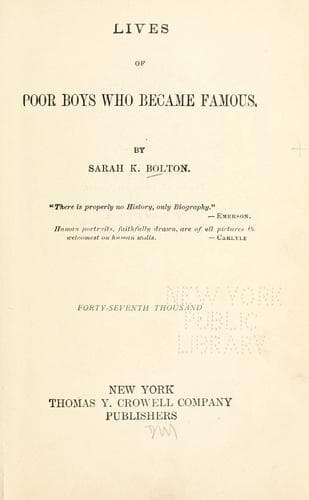
Lives of Poor Boys Who Became FamousBolton, Sarah Knowles
History
Lives of Poor Boys Who Became Famous
Bolton, Sarah Knowles
Biography
Jacquard with all earthly ties severed went back to the seclusion of
inventing. After his day's work was done as a laborer, he studied on his
machine for silk-weaving. Finally, after seven years,--a long time to
patiently develop an idea,--he had produced a loom which would decrease
the number of workmen at each machine, by one person. The model was
placed at the Paris Industrial Exposition in 1801; and the maker was
awarded a bronze medal. In gratitude for this discovery he went to the
image of the Virgin which stood on a high hill, and for nine days
ascended daily the steps of the sacred place. Then he returned to his
work, and seating himself before a Vaucanson loom, which contained the
germ of his own, he consecrated himself anew to the perfecting of his
invention.
Jacques de Vaucanson, who died when Jacquard was thirty years old, was
one of the most celebrated mechanicians of France. His automatons were
the wonder of the age. He exhibited a duck which, when moved, ate and
drank like a live one. The figure would stretch out its neck for food,
and swallow it: walk, swim, dabble in the water, and quack most
naturally. His musician, playing the flageolet with the left hand, and
beating the tambourine with the right, executing many pieces of
difficult music with great accuracy, was an astonishment to every body.
He had been appointed inspector of silk-factories at Lyons, and, because
he made some improvements in machines, he was pelted with stones by the
workmen, who feared that they would thereby lose their labor. He
revenged himself by making a machine which wove, brocaded, and colored
at the same time, and was worked by a donkey!
It remained for Jacquard to make the Vaucanson loom of the utmost
practical use to Lyons and to the world. After a time he was not only
able to dispense with one workman at each loom, but he made machinery do
the work of three men and two women at each frame. The city authorities
sent a model of this machine to Paris, that the Emperor Napoleon might
examine it. So pleased was he that he at once sent for Jacquard to come
to Paris. The latter had previously invented a machine for making
fishing-nets, now used in producing Nottingham lace. When brought before
Bonaparte, and Carnot the Minister of the Interior, the latter asked,
"Is it you then, who pretend to do a thing which is impossible for
man,--to make a knot upon a tight thread?"
Jacquard answered the brusque inquiry by setting up a machine, and
letting the incredulous minister see for himself.
Public-domain text, read in full here on John Shaqi.
Reviews
Reviews
No reviews yet
Be the first to share your thoughts on this work.
Elsewhere in the archive
Join the Discussion
Join the discussion
Sign in to leave a comment or review.
Sign InorCreate an account