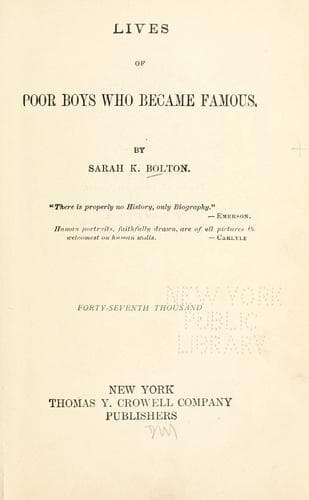
Lives of Poor Boys Who Became FamousBolton, Sarah Knowles
History
Lives of Poor Boys Who Became Famous
Bolton, Sarah Knowles
Biography
The following year, as the managers of the American Colonization Society
had sent an agent to England, it was deemed best to send Garrison abroad
to tell Wilberforce and others who were working for the suppression of
slavery in the West Indies, that it was not a wise plan to send the
slaves to Africa. It was difficult to raise the money needed; but
self-sacrifice usually leaves a good bank-account. The "fanatic," only
twenty-eight, was received with open arms by such men as Lord Brougham,
Wilberforce, Clarkson, and Daniel O'Connell. Sir Thomas Fowell Buxton
gave a breakfast in his honor. When the guests had arrived, among them
Mr. Garrison, Mr. Buxton held up both hands, exclaiming, "Why, my dear
sir, I thought you were a black man!" This, Mr. Garrison used to say,
was the greatest compliment of his life, because it showed how truly and
heartily he had labored for the slave. A great meeting was arranged for
him at Exeter Hall, London. How inspiring all this for the young
reformer! Here he met the eloquent George Thompson, and asked him to
visit our country, which invitation he accepted.
On his return the American Anti-Slavery Society was formed, Dec. 4,
1833, at Philadelphia, delegates coming from eleven States. John G.
Whittier was chosen Secretary. The noble poet has often said that he was
more proud that his name should appear signed to the Declaration of
Principles adopted at that meeting than on the title-page of any of his
volumes. Thus has he ever loved liberty.
The contest over the slavery question was growing extremely bitter.
Prudence Crandall of Canterbury, Conn., a young Quaker lady, admitted
several colored girls to her school, who came from Boston, New York, and
Philadelphia. The people were indignant at such a commingling of races.
Shopkeepers refused to sell her anything; her well was filled with
refuse, and at last her house was nearly torn down by a midnight mob.
Lane Theological Seminary, Cincinnati, Western Reserve College, Hudson,
O., with some others, were nearly broken up by the conflict of opinion.
Some anti-slavery lecturers were tarred and feathered or thrown into
prison. In New York, a pro-slavery mob broke in the doors and windows of
a Presbyterian church, and laid waste schoolhouses and dwellings of
colored people. In Philadelphia, the riots lasted three days, forty-four
houses of colored people being nearly or quite destroyed.
In Boston, a "most respectable" mob, composed, says Horace Greeley, "in
good part of merchants," dispersed a company of women belonging to the
Female Anti-Slavery Society, while its President was engaged in prayer.
Learning that Garrison was in the adjoining office, they shouted, "We
must have Garrison! Out with him! Lynch him!"
Public-domain text, read in full here on John Shaqi.
Reviews
Reviews
No reviews yet
Be the first to share your thoughts on this work.
Elsewhere in the archive
Join the Discussion
Join the discussion
Sign in to leave a comment or review.
Sign InorCreate an account