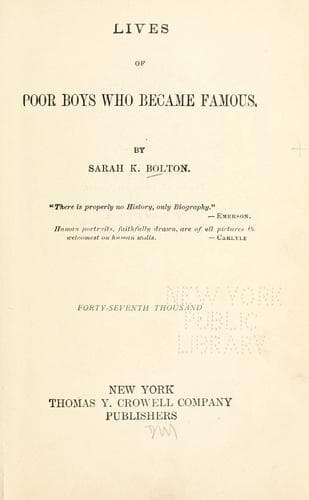
Lives of Poor Boys Who Became FamousBolton, Sarah Knowles
History
Lives of Poor Boys Who Became Famous
Bolton, Sarah Knowles
Biography
From this time till 1860 the struggle between freedom and slavery was
continuous. The South needed the Territories for her rapid increase of
slaves. The North was opposed; but in the year 1854 the Kansas-Nebraska
Act, devised by Stephen A. Douglas, repealed the Missouri Compromise of
1820, which had prohibited slavery north of latitude 36 deg. 30', the
southern boundary of Kansas. Kansas at once became a battle-ground.
Armed men came over from Missouri to establish slavery. Men came from
New England determined that the soil should be free, if they spilled
their blood to gain it. The Fugitive Slave Law, whereby slaves were
returned without trial by jury, and slave-owners allowed to search the
North for their slaves, made great bitterness. The brutal attack of
Preston Brooks, of South Carolina, on Charles Sumner, for his speech on
Kansas, and the hanging of John Brown by the State of Virginia for his
invasion of Harper's Ferry with seventeen white men and five negroes,
calling upon the slaves to rise and demand their liberty, brought
matters to a crisis.
Garrison was opposed to war; but after the firing on Sumter, April 12,
1861, it was inevitable. For two years after Abraham Lincoln's election
to the Presidency, Garrison waited impatiently for that pen-stroke which
set four million human beings free. When the Emancipation Proclamation
was issued, Jan. 1. 1863, Garrison's life-work was accomplished.
Thirty-five years of untiring, heroic struggle had not been in vain.
When two years later the stars and stripes were raised again over Fort
Sumter, he was invited by President Lincoln, as a guest of the
government, to witness the imposing scene. When Mr. Garrison arrived in
Charleston, the colored people were nearly wild with joy. Children sang
and men shouted. A slave made an address of welcome, his two daughters
bearing a wreath of flowers to their great benefactor. Garrison's heart
was full to overflowing as he replied, "Not unto us, not unto us, but
unto God be all the glory for what has been done in regard to your
emancipation.... Thank God, this day, that you are free. And be resolved
that, once free, you will be free forever. Liberty or death, but never
slavery! While God gives me reason and strength, I shall demand for you
everything I claim for the whitest of the white in this country."
The same year he discontinued the publication of the "Liberator,"
putting in type with his own hands the official ratification of the
Thirteenth Amendment, forever prohibiting slavery in the United States,
and adding, "Hail, redeemed, regenerated America! Hail, all nations,
tribes, kindred, and peoples, made of one blood, interested in a common
redemption, heirs of the same immortal destiny! Hail, angels in glory;
tune your harps anew, singing, 'Great and marvellous are thy works, Lord
God Almighty!'"
Public-domain text, read in full here on John Shaqi.
Reviews
Reviews
No reviews yet
Be the first to share your thoughts on this work.
Elsewhere in the archive
Join the Discussion
Join the discussion
Sign in to leave a comment or review.
Sign InorCreate an account