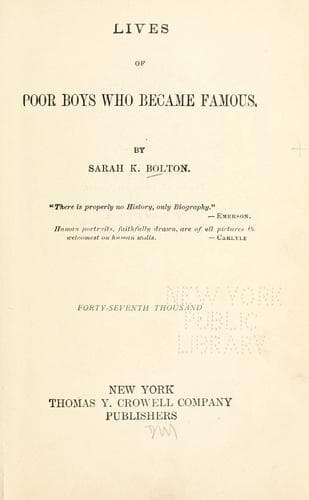
Lives of Poor Boys Who Became FamousBolton, Sarah Knowles
History
Lives of Poor Boys Who Became Famous
Bolton, Sarah Knowles
Biography
At twenty-one, we find Garibaldi second in command on the brig
"Cortese," bound for the Black Sea. Three times during the voyage they
were plundered by Greek pirates, their sails, charts, and every article
of clothing taken from them, the sailors being obliged to cover their
bodies with some matting, left by chance in the hold of the ship. As a
result of this destitution, the young commander became ill at
Constantinople, and was cared for by some Italian exiles. Poor, as are
most who are born to be leaders, he must work now to pay the expenses
incurred by this illness. Through the kindness of his physician, he
found a place to teach, and when once more even with the world
pecuniarily, went back to sea, and was made captain.
He was now twenty-seven years old. Since his father had taken him when a
mere boy to Rome, he had longed for and prayed over his distracted
Italy. He saw what the Eternal City must have been in her ancient
splendor; he pictured her in the future, again the pride and glory of a
united nation. He remembered how Italy had been the battle-ground of
France, Spain, and Austria, when kings, as they have ever done,
quarrelled for power. He saw the conqueror of Europe himself conquered
by the dreadful Russian campaign: then the Congress of Vienna parcelling
out a prostrate people among the nations. Austria took Lombardy and
Venice; Parma and Lucca were given to Marie Louise, the second wife of
Napoleon; and the Two Sicilies to Ferdinand II., who ruled them with a
rod of iron. Citizens for small offences were lashed to death in the
public square. Filthy dungeons, excavated under the sea, without light
or air, were filled with patriots, whose only crime was a desire for a
free country. The people revolted in Naples and Sardinia, and asked for
a constitution; but Austria soon helped to restore despotism. Kings had
divine rights; the people had none. No man lessens his power willingly.
The only national safety is the least possible power in the hands of any
one person. The rule of the many is liberty; of the few, despotism.
Garibaldi was writing all these things on his heart. His blood boiled at
the slavery of his race. Mazzini, a young lawyer of Genoa, had just
started a society called "Young Italy," and was looking hopefully, in a
hopeless age, toward a republic for his native country. Garibaldi was
ready to help in any manner possible. The plan proposed was to seize the
village of St. Julien, and begin the revolt; but, as usual, there was a
traitor in the camp: they were detected; and Garibaldi, like the rest,
was sentenced to death. This was an unexpected turn of events for the
young sea-captain. Donning the garb of a peasant, he escaped by mountain
routes to Nice, his only food being chestnuts, bade a hasty farewell to
his precious mother, and started for South America. He had learned,
alas, so soon, the result of working for freedom in Italy!
Public-domain text, read in full here on John Shaqi.
Reviews
Reviews
No reviews yet
Be the first to share your thoughts on this work.
Elsewhere in the archive
Join the Discussion
Join the discussion
Sign in to leave a comment or review.
Sign InorCreate an account