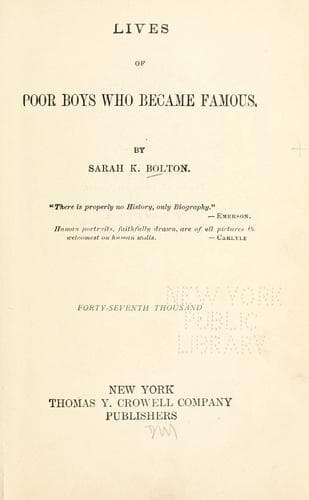
Lives of Poor Boys Who Became FamousBolton, Sarah Knowles
History
Lives of Poor Boys Who Became Famous
Bolton, Sarah Knowles
Biography
In 1874, after helping the French Republic, the brave Spartan was
elected to Parliament. He was now sixty-seven. As he entered Rome, the
streets were blocked with people, who several times attempted to remove
the horses, and draw the carriage themselves. Ah! if Anita had only
been there to have seen this homage of a grateful nation. He entered the
Senate House on the arm of his son Menotti, and when he rose in his red
shirt and gray cloak to take the oath, so infirm that he was obliged to
be supported by two friends, men wept as they recalled his struggles,
and shouted frantically as he took his seat.
Seven years longer the grand old man lived at Caprera, now beautified
with gifts from all the world, the recipient of a thank-offering of
$10,000 yearly from Italy. Around him were Francesca, whom he married
late in life, and their two children whom he idolized,--Manlio and
Clelia. He spent his time in writing several books, in tilling the soil,
and in telling visitors the wonderful events of his life and of Anita.
On June 2, 1882, all day long he lay by the window, looking out upon the
sea. As the sun was setting, a bird alighted on the sill, singing. The
great man stammered, "Quanti o allegro!" How joyful it is! and closed
his eyes in death. He directed in his will that his body should be
burned; but, at the request of the Government and many friends, it was
buried at Caprera, to be transferred at some future time to Rome, now
the capital of united Italy. Not alone does Italy honor her great
Liberator, whom she calls the "most blameless and most beloved of men."
Wherever a heart loves liberty, there will Garibaldi's name be cherished
and honored.
JEAN PAUL RICHTER.
Vasari, who wrote the lives of the Italian painters, truly said, "It is
not by sleeping, but by working, waking, and laboring continually, that
proficiency is attained and reputation acquired." This was emphatically
true of Richter, as it is of every man or woman who wins a place in the
memory of men. The majority die after a commonplace life, and are never
heard of; they were probably satisfied to drift along the current, with
no especial purpose, save to eat, drink, and be merry.
Not so with the German boy, born in the cold Pine Mountains of Bavaria.
His home was a low, thatched building, made of beams of wood, filled in
with mortar, one part for the family, and the other for corn and goats.
This is still the custom in Switzerland, the poor caring as tenderly for
their dumb beasts as for their children. Jean Paul was born on the 21st
of March, 1763: "My life and the life of the spring began the same
month," he used to say in after years, and the thought of robin
red-breasts and spring flowers made the poor lad happy amid the deepest
trials.
Public-domain text, read in full here on John Shaqi.
Reviews
Reviews
No reviews yet
Be the first to share your thoughts on this work.
Elsewhere in the archive
Join the Discussion
Join the discussion
Sign in to leave a comment or review.
Sign InorCreate an account