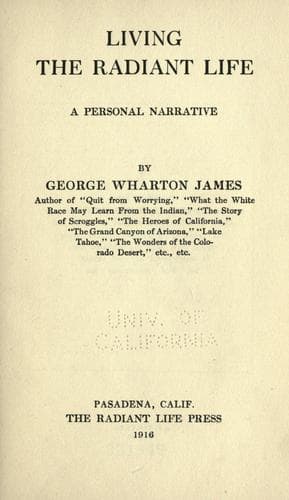
Living the Radiant Life: A Personal NarrativeJames, George Wharton
Religion
Living the Radiant Life: A Personal Narrative
James, George Wharton
Conduct of life
I think I can fairly hold my own in such a combat, and the
audience that was assembled, generally seemed to think so, but imagine
the way the fur began to fly when Hubbard arrived and chipped in, and
Marshall and Von, and Bert II, and each of the others. Talk about a
stranger dog set on by a dozen home dogs--it was nothing, compared with
the fun we had badgering and baiting that over-confident spieler. Then I
moved on to the next stand, far enough away, however, so that no one
was aware of our plot. The crowd soon "tumbled" and followed, and we
repeated the game to the infinite amazement of the discomfited
"barkers." It was the wildest revelry of good-natured, good-humored,
spontaneous fun I have ever engaged in, and a thousand years can never
efface its memory.
Dignity! What had we to do with dignity? We were fun-makers,
delight-makers, like the old-time Indians of the cliff-dwelling days,
and we went into the game with vim, energy, earnestness, abandon, and
enthusiasm.
And I learned a wonderful lesson, once, from Marshall Wilder, that was
worth many a long-winded sermon for practical usefulness in meeting the
hardships, the woes, the pains of life. I was on the stage of a theater
with him, just preparatory to his "act." He was suffering excruciating
agony--as he often did, from his frail and deformed body--and sweat was
pouring down his brow and cheeks. "Put your arms around me, and love me
tight, George!" he gasped, "hold me tight," and I held him, clasping his
hands also in mine. He gripped me with fierce intensity, clearly
indicating the pain he was in, and thus we stood, until the call came
for him. Then, wiping his brow and face, with a smile that was at once
ghastly and sweet in its pathos, he rushed before his audience, and had
them laughing at his merry quips and quirks, his jests and jokes,
before I could recover from the sympathy I felt for his deep suffering.
Brave, courageous, plucky Marsh. Ready to make fun for others in spite
of his own pain. How often when men come to me with long drawn-out tales
of their woes, _their_ pains, _their_ sufferings, _their_ trials,
_their_ hardships, do I feel like saying to them: "Cut it out! Go and do
as did Marsh Wilder. Make some one else laugh. Make some one else happy,
and you'll forget your own troubles!" For it is true. The very effort of
concentration upon making others laugh, or add to their happiness,
largely, if not completely, leads to a forgetfulness of one's own woes.
Public-domain text, read in full here on John Shaqi.
Reviews
Reviews
No reviews yet
Be the first to share your thoughts on this work.
Elsewhere in the archive
Join the Discussion
Join the discussion
Sign in to leave a comment or review.
Sign InorCreate an account