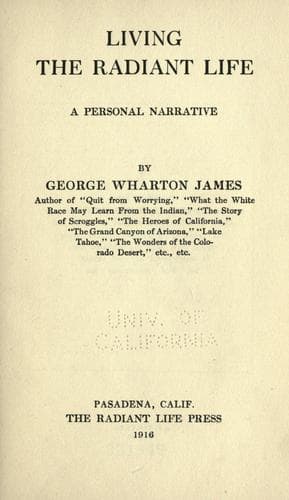
Living the Radiant Life: A Personal NarrativeJames, George Wharton
Religion
Living the Radiant Life: A Personal Narrative
James, George Wharton
Conduct of life
This may not be a scientific classification, but it suffices for my
purpose. I have not put the most important first, but observation is the
one man most relies upon.
1. Observation is God's method of filling up the inner supply of man's
knowledge through the senses. He sees, feels, hears, smells, tastes, and
through these avenues receives mental impressions. One can observe the
lower things or the higher. Every day as I ride on the train or street
cars, I observe men reading their newspapers. As a rule I can tell in a
few minutes what a man's mental hunger is by watching him read. He
chooses the pink sheet and devours with avidity the stories of prize
fights. He turns to the pages devoted to courts and reads the accounts
of murder trials or of scenes where lawyers quarrel or jangle and where
witnesses testify to disgusting and loathsome things. Another man is
interested in clean athletics and reads with interest of college
football, Marathon games, and the like. Still another is absorbed in the
news of a higher nature, a meeting of the Hague Peace Conference, the
endeavors of statesmen to bring about a better understanding between the
North and the South, between nations. In other words, a man takes what
his appetite craves out of the newspaper. Just so it is with all life.
Men take whatever their appetites crave. If the appetite is false,
unnatural, abnormal, they take injurious food. Only when the depraved
appetite becomes changed into natural, normal hunger, is the right kind
of food sought and found. Yet there is immeasurably more of the pure,
good food to satisfy the perfect, normal hunger, than there is of the
carrion which the vulture instincts in us crave.
2. Reading. While I have put this under a separate head, it really
belongs under the head of observation, for the reading of books is but
observation of the observations of other men. Yet, as I shall show
later, this is a special field which one should endeavor to glean with
care.
3. Intuition. To the really normally hungry soul, this is the chief,
indeed, the only source of spiritual food. It is what Emerson called the
"Oversoul," and what Doctor Buck meant when, in speaking of Walt
Whitman, he said he possessed the "cosmic conscience." It is
receptiveness to universal truth, Divine truth, that truth which knows
no time, no place, no boundaries of nationality, no difference in creed,
in sect, in sex, in color, but that, like the sun, shines alike upon
all, whether bond or free, rich or poor, learned or unlearned, black,
white, brown, or red, savage or civilized. It is the spirit that
possessed--in varying degrees--Gautama, Buddha, Confucius, Mahomet,
Jesus, Joan of Arc, Emerson, Browning, Whitman, all great souls who have
seen the truth universal and recorded it for the uplift and ennobling of
mankind.
Public-domain text, read in full here on John Shaqi.
Reviews
Reviews
No reviews yet
Be the first to share your thoughts on this work.
Elsewhere in the archive
Join the Discussion
Join the discussion
Sign in to leave a comment or review.
Sign InorCreate an account