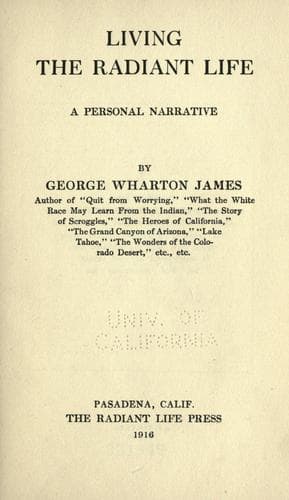
Living the Radiant Life: A Personal NarrativeJames, George Wharton
Religion
Living the Radiant Life: A Personal Narrative
James, George Wharton
Conduct of life
By way of parenthesis, it is interesting here to add that in _The
Christian_ (a London, England, weekly paper), for September 17, 1910,
there was a letter giving an even earlier use of the phrase, as follows:
SIR: In your report of Principal Carpenter's striking speech at
Budapest, you cite his reference to the well-known fact that "It was
from Parker that Abraham Lincoln borrowed his famous phrase,
'Government of the people, for the people and by the people.'" But
the further fact should be remembered that Parker himself borrowed
it--doubtless through his perusal of the current _Monthly
Repository_--from Rev. Robert Aspland, our once-famous Hackney
minister. It occurs in Mr. Aspland's speech at the great Whig
banquet of 1828, which celebrated the repeal of the Test and
Corporation Acts, and at which, amongst many distinguished speakers,
Mr. Aspland, by common consent, bore away the palm of eloquence.--AN
EX-M. P.
These facts in the history of a great phrase I am glad to present, but
the most important fact is not the name of the originator, but the names
of the men who made the phrase live in the hearts of their fellows as
biting, stinging, awakening truths. Parker was one of these. Lloyd
Garrison, Wendell Phillips, John G. Whittier, Lowell, John Brown,
Lovejoy, Lincoln, were others. And you and I, friendly reader, are
to-day basking in the fuller and larger sunlight of freedom let into the
house of our common humanity by the fearless, uncompromising, daring
courage of these men.
Let us not be laggards in the army of human progress; nor content even
to be abreast with the times. Let us be athirst for deeper waters,
clearer streams. Let us get nearer the mountain top than either of these
two crowds. Let us drink of the fountain spring itself and know nothing
else but the fundamental principles of human relationship, and, drinking
of them to the full, go forth and radiate them in their original purity,
sweetness, and power, diluted only by our imperfect human expression.
Let us, in this and all similar matters, make the words of Browning
ours, that we may ringingly declare to the world as well as quietly
radiate them:
What had I on Earth to do
With the slothful, with the mawkish, the unmanly?
Like the aimless, helpless, hopeless, did I drivel--Being--who?
One who never turned his back but marched breast forward,
Never doubted clouds would break,
Never dreamed, though right were worsted, wrong would triumph,
Held we fall to rise, are baffled to fight better, sleep to wake.
Public-domain text, read in full here on John Shaqi.
Reviews
Reviews
No reviews yet
Be the first to share your thoughts on this work.
Elsewhere in the archive
Join the Discussion
Join the discussion
Sign in to leave a comment or review.
Sign InorCreate an account