London (England) -- History; London (England) -- Social life and customs
The city associated the new prosperity with their Maiden Queen, for whom
their love and loyalty never abated in the least. When she asked them
for a certain number of ships they sent double the number, fully manned
and provided; when the Queen's enemy, Mary of Scotland, was beheaded,
they rang their bells and made bonfires; while the Queen was living they
thanked God solemnly for her long reign; when she died, their
lamentations were loud and sincere; her monument, until the fire,
adorned many of the city churches. One of the Elizabeth statues yet
remains outside the Church of St. Dunstan's, Fleet Street. It is the
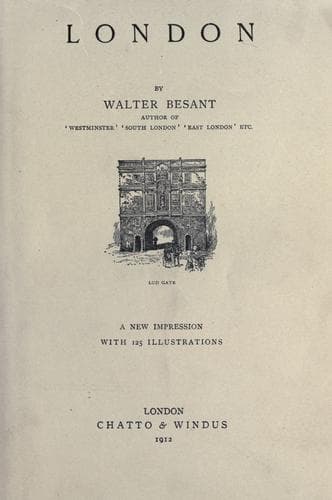
statue which formerly stood on the west side of Lud Gate.
[Illustration: THE STEEL YARD, ETC., THAMES STREET, AFTER THE GREAT FIRE
OF 1666]
To return to Gresham. He not only gave the city a Bourse, but he also
endowed it with a college, which should have been a rival of Trinity or
Christ Church but for the mismanagement which reduced it for a long time
to the level of a lecture institute. The idea of the founder will, no
doubt, be revived some time or other, and Gresham College will become a
place of learning worthy of the city.
The career of Sir Thomas Gresham strangely resembles that of
Whittington. Both were favorites with successive sovereigns. If Gresham
built an Exchange, Whittington, by his will, added to Guildhall; if
Gresham founded a college for the London youth, Whittington founded a
college for priests, and an almshouse; if Gresham restored the finances
of his sovereign, Whittington gave back to his the bonds of all his
debts. Both were mercers; both merchant adventurers; both kept a shop;
both were of good descent.
Gresham's shop was in Lombard Street, at the Sign of the Grasshopper,
his family crest. His shop contained gold and silver vessels; coins,
ancient and modern; gold chains, gold and silver lace, rings, and
jewels. He lent money, as most bankers do, on security, but he got 10
and 12 per cent. for it. He had correspondents abroad, and he gave
travellers letters of credit; he bought foreign coin either to exchange
or to melt down. And he lived in his own house, over his shop, until he
was knighted, when he built a new house between Bishopsgate Street and
Broad Street. Stow calls it "the most spacious of all thereabout;
builded of brick and timber." This house became afterwards Gresham
College.
[Illustration: COLLEGII GRESHAMENSIS A LATERE OCCIDENTALI PROSPECTUS,
A.D. 1739]
Public-domain text, read in full here on John Shaqi.
Reviews
Reviews
No reviews yet
Be the first to share your thoughts on this work.
Elsewhere in the archive
Join the Discussion
Join the discussion
Sign in to leave a comment or review.
Sign InorCreate an account