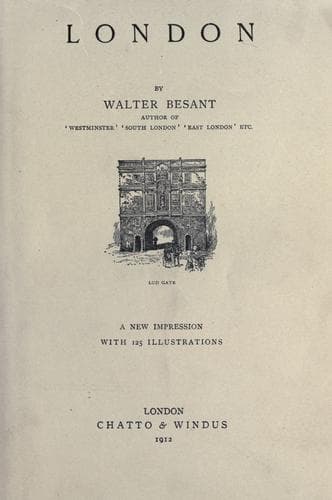
London (England) -- History; London (England) -- Social life and customs
"The place is much despoiled," said the antiquary, "since the days of
the old religion. Many things have been taken down which formerly
beautified the church-yard. For instance, on this very spot, covered now
with dwelling-houses and shops, was the Charnel Chapel, as old as King
Edward the First. It was a chapel of the Blessed Virgin. Sir Richard
Whittington endowed it with a chaplain. There were two brotherhoods; its
crypt was filled with bones; the chapel was filled with monuments. One
would have thought that reverence for the bones would have sufficed to
preserve the chapel. But no. It was in the reign of Edward the Sixth,
when everything was destroyed. The Duke of Somerset pulled down the
chapel. The bones he caused to be placed in carts--they made a thousand
loads--and to be carried to Finsbury Fields, where they were thrown out
and strewn around--a pitiful spectacle. Beside the Charnel Chapel was
the Chapel of the Holy Ghost, served by the seven chaplains of Holme's
College, on the south side of the church-yard. That, too, was destroyed.
But most of all I lament the destruction of the Pardon Church-yard.
Truly this was one of the wonders of London. There stands the plot of
ground, a garden now for the minor canons, but formerly a cloister
wherein were buried many persons of worship, and some of honor, whose
monuments were of curious workmanship. Round the cloister was painted a
dance of death, commonly called the Dance of Paul's, with verses by John
Lydgate, done at the dispense of John Carpenter. Over the east quadrant
was a fair library, given by Walter Sherrington, chancellor to Henry the
Sixth; and in the cloister was a chapel, built by the father of Thomas à
Becket, who lay buried there. Of such antiquity was this beautiful and
venerable place. Neither its age nor its beauty could save it. Nor could
the lesson concerning the presence of death, in this lively portraiture,
save it. Down it must come, and now there remains but two or three old
men like myself who can remember the Dance of Paul's. Well, the figure
of death is gone, but death himself we cannot drive away. There is
Paul's Cross." He pointed to an edifice at the north-east angle of the
transept.
I looked with curiosity at this historical edifice, which was smaller,
as all historical things are, than one expected. It was made of timber,
mounted upon steps of stone, and covered with lead. There was room in it
for three or four persons; a low wall was built round it. A venerable
man was preaching to a small congregation, who sat on wooden benches to
listen.
Public-domain text, read in full here on John Shaqi.
Reviews
Reviews
No reviews yet
Be the first to share your thoughts on this work.
Elsewhere in the archive
Join the Discussion
Join the discussion
Sign in to leave a comment or review.
Sign InorCreate an account