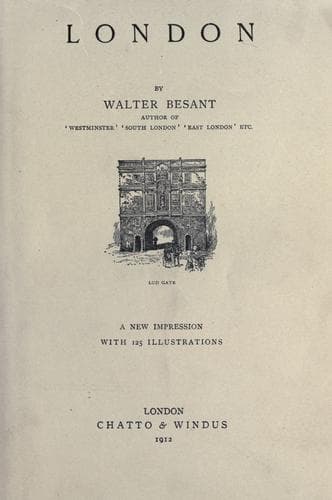
London (England) -- History; London (England) -- Social life and customs
When it abated at last, and the runaways went back to town, Pepys among
them, he notes the amazing number of beggars. These poor creatures were
the widows or children of the craftsmen, or the craftsmen themselves
whose ruin we have just noted.
This was in January. The Plague, however, dragged on. In the week ending
March 1, 1666, there were forty-two deaths from it. In the month of July
it was still present in London, and reported to be raging at Colchester.
In August, Pepys finds the house of one of his friends in Fenchurch
Street shut up with the Plague, and it was said to be as bad as ever at
Greenwich. This was the last entry about it, because in a week or two
there was to happen an event of even greater importance than this great
Plague.
Observe that this was the last appearance of the Plague. Since 1665 it
has never appeared in Europe, except in Marseilles in the year 1720. It
is not extinct. It smoulders, like Vesuvius. There is nothing, so far as
can be understood, to prevent its reappearance in London or anywhere
else, unless it is the improved sanitation of modern cities. For
instance, it was at Astrakhan in 1879. But it travelled no farther west.
It is generated in the broad miasmatic valley of the Euphrates; there it
lies, ready to be carried about the world, the last gift of Babylon to
the nations. When that great city is built again, the centre of commerce
between Europe and the East, the valley will once more be drained and
cultivated, and the Plague will die and be no more seen. But who is to
rebuild Babylon and to repeople the land of the Assyrians?
There were two great Plagues of London in the seventeenth century before
this--the last and greatest--one in 1603 and the other in 1625. I have
before me two contemporary tracts upon these plagues. They illustrate
what has been said of the Plague of 1665. Exactly the same things
happened. In listening either to him of 1603, or to him of 1625, one
hears the voice of 1665. I think that these tracts have never before
been quoted. Yet it is quite clear to me that Defoe must have seen them
both.
The first is called _The Wonderful Year_, 1603. The author, who is
anonymous, begins with weeping over the death of Queen Elizabeth. This
tribute paid, with such exaggerated grief as belongs to his sense of
loyalty, he rejoices, with equal extravagance, over the accession of
James. This brings him to his real subject:
Public-domain text, read in full here on John Shaqi.
Reviews
Reviews
No reviews yet
Be the first to share your thoughts on this work.
Elsewhere in the archive
Join the Discussion
Join the discussion
Sign in to leave a comment or review.
Sign InorCreate an account