London (England) -- History; London (England) -- Social life and customs
The gates still stood, and were closed at sunset, until the year 1760.
Then they were all pulled down, and the materials sold. Temple Bar,
which was never a City gate, properly speaking, remained until the other
day. The gates were, I suppose, an obstruction to traffic, yet one
regrets their disappearance. They were not old, but they had a character
of their own, and they preserved the memory of ancient sites. I wish
they could have been preserved to this day. A statue of Queen Elizabeth,
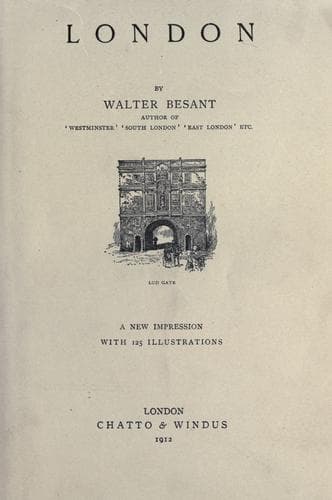
which formerly stood on the west front of Lud Gate, is, I believe, the
only part of a City gate not destroyed. It is now placed on the south
wall of St. Dunstan's, Fleet Street, where thousands pass by every day,
regardless of this monument of London before the fire!
I have found, in a pamphlet written (1754) to advocate certain
improvements in the City, glimpses of things too petty for the dignity
of history, yet not without interest to one who wishes to reconstruct
the life of the time. For instance, the streets were not cleaned,
except in certain thoroughfares; at the back of the Royal Exchange, for
instance, was a scandalous accumulation of filth suffered to remain, and
the posterns of the City gates were equally neglected and abused. The
rubbish shot into the streets was not cleared away; think of the streets
all discharging the duty of the dust-bin! Cellar doors and windows were
left open carelessly; stone steps projected from the houses far across
the foot-path. Where pavement had been laid down it was suffered to
become broken and ruinous, and so left. Houses that had fallen down or
been burned down were left unbuilt, an ugly hole in the line of the
street. Sheds for shops were placed against the walls of churches, as at
St. Antholin's, Budge Row, and at St. Ethelburga's, where they still
remain, transformed into houses. Sheds for shops have been built out in
the street before the houses in certain places. Houses rebuilt are
pushed forward into the street. Live bullocks driven through the streets
are a constant danger; mad dogs are another danger--why is there no tax
on dogs? Beggars and vagrants swarm in every street. The common people
practise habitually a profaneness of speech which is shocking. These are
some of the things complained of by my pamphleteer. He next advocates
certain improvements. He would establish a public Mercantile Library--we
now have it at the Guildhall. He complains that the City gates have been
encroached upon and defaced--six years later they were taken down. He
shows us that while within the City itself there were oil-lamps set up
at regular intervals in all the streets, there were none outside the
Freedom. At that time beyond St. Martin's le Grand, and in the district
of St. Bartholomew's, the streets were left in darkness absolute. This
was shortly afterwards remedied. He wants stronger and stouter men for
the City watch, and would have some stationed in different parts of the
City in the daytime.
Public-domain text, read in full here on John Shaqi.
Reviews
Reviews
No reviews yet
Be the first to share your thoughts on this work.
Elsewhere in the archive
Join the Discussion
Join the discussion
Sign in to leave a comment or review.
Sign InorCreate an account