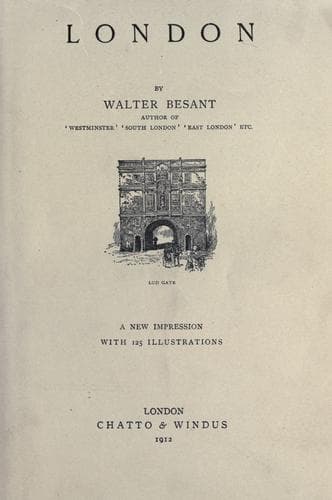
London (England) -- History; London (England) -- Social life and customs
The principle of life assurance was already well established, but not
yet in general use. There seem to have been no more than four companies
for life assurance. The Post-office rates varied with the distance. A
letter from London to any place not exceeding one stage cost twopence;
under two stages, threepence; under eight miles, fourpence; under 150
miles, fivepence; above 150 miles, to any place in England, sixpence; to
Scotland, sevenpence; to Ireland, sixpence; to America and the West
Indies, a shilling; to any part of Europe, a shilling to eighteenpence.
There was also a penny post, first set up in London by a private person.
This had five principal offices. Letters or packets not exceeding four
ounces in weight were carried about the City for one penny, and
delivered in the suburbs for a penny more. There were no bank-notes of
less than £20 before the year 1759; but when the smaller notes were
issued, and came into general use, people very soon found out the plan
of cutting them in two for safety in transmission by post.
Mail-coaches started every night at eight o'clock with a guard. They
were timed for seven miles an hour, and the fare for passengers was
fourpence a mile. A passenger to Bristol, for example, who now pays
twenty shillings first-class fare and does the journey in two hours and
a half, then paid thirty-three and fourpence, and took fourteen hours
and a quarter. A great many of the mails started from the Swan with Two
Necks, a great hostelry and receiving-place in Lad Lane. The place is
now swept away with Lad Lane itself. It stood in the part of Gresham
Street which runs between Wood Street and Milk Street.
The stage-coaches from different parts of London were innumerable, as
were also the stage-wagons and the hoys. The coaches charged the
passengers threepence a mile. Hackney-coaches ran for shilling and
eighteenpenny fares. There were hackney-chairs. In the City there were
regular porters for carrying parcels and letters.
There were nine morning papers, of which the _Morning Post_ still
survives. They were all published at threepence. There were eight
evening papers, which came out three times a week. And there were three
or four weekly papers, intended chiefly for the country.
The stamps which had to be bought with anything were a grievous burden.
A pair of gloves worth tenpence--stamp of one penny; worth one and
fourpence--stamp of twopence; above one and fourpence--stamp of
fourpence. Penalty for selling without a stamp, £5. Hats were taxed in
like manner. Inventories and catalogues were stamped; an apprentice's
indentures were stamped; every newspaper paid a stamp of three
halfpence. In the year 1753 there were seven millions and a half of
stamps issued to the journals.
Public-domain text, read in full here on John Shaqi.
Reviews
Reviews
No reviews yet
Be the first to share your thoughts on this work.
Elsewhere in the archive
Join the Discussion
Join the discussion
Sign in to leave a comment or review.
Sign InorCreate an account