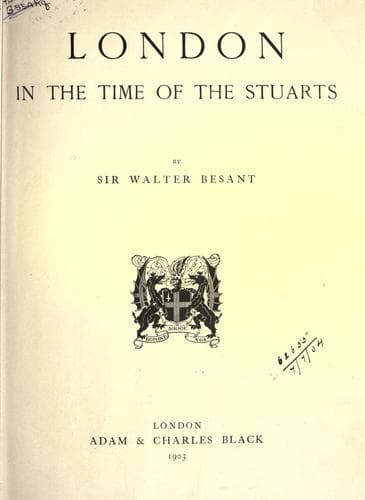
London (England) -- History -- 17th century; London (England) -- Social life and customs -- 17th century
“Your Majesty having declared your gracious pleasure to proceed only
against the murderers of your royal Father, we, your Majesty’s most
humble subjects, the Lords and Commons assembled, not finding Sir Henry
Vane or Colonel Lambert to be of the number, are humble suitors to your
Majesty that, if they shall be attainted, execution of their lives may
be remitted.”
Charles broke his word and Vane was executed, showing to the last the
firmness and courage which only a good conscience could give, this
belongs to national history. He suffered on Tower Hill. His friends
urged him after his sentence to make submission to the King. He
replied:—
“If his Majesty does not think himself more concerned for his honour
and word than I am for my life, I am very willing he should take it;
and I declare that I value my life less in a good cause than the King
does his promise.” (_Clayton_, ii. p. 164.)
Sir Harry Vane was a scholar of Oxford; he had travelled in France and
stayed awhile in Geneva, where he had adopted the religious principles
which ruled him through life. So much was he considered when quite
young that the King entreated Laud to bring him to a more orthodox
way of thinking. To avoid Laud’s frequent reproofs Vane went to
America, where, at the age of four-and-twenty, he became Governor of
Massachusetts Bay.
The Act of Indemnity excluded the late King’s judges and certain
persons who had been active in procuring the King’s execution. The
trials of the State prisoners under the exceptions of this Act took
place at the Old Bailey. On October 11 they were all sentenced to death
as traitors, with the customary barbarities. Major-General Harrison,
the Rev. Hugh Peters, Mr. Thomas Scot, Mr. Gregory Clement, and
Colonels Scroop (or Scrope), John Jones, Francis Hacker, and Daniel
Axtell were sentenced. Most of them were executed at Charing Cross.
The case of Harrison was the most important. There is no doubt that
he took an active part in bringing Charles to the block; yet he
subsequently refused to assist Cromwell in his ambitions; he was
imprisoned by Cromwell and deprived of his commission; on his release
he retired to a private life, and refused to fly when the King
returned. Brought before the Court, he made no attempt to deny the
fact; on the contrary he gloried in it:—
Public-domain text, read in full here on John Shaqi.
Reviews
Reviews
No reviews yet
Be the first to share your thoughts on this work.
Elsewhere in the archive
Join the Discussion
Join the discussion
Sign in to leave a comment or review.
Sign InorCreate an account