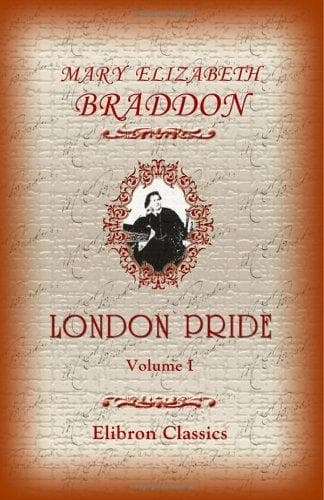
London Pride, Or, When the World Was YoungerBraddon, M. E. (Mary Elizabeth)
History
London Pride, Or, When the World Was Younger
Braddon, M. E. (Mary Elizabeth)
Great Britain -- History -- Charles II, 1660-1685 -- Fiction; London (England) -- Fiction
The barge was used on festive occasions, or for country voyages, as to
Hampton or Greenwich; the wherries were in constant requisition. Along
that shining waterway rank and fashion, commerce and business, were
moving backwards and forwards all day long. That more novel mode of
transit, the hackney coach, was only resorted to in foul weather; for
the Legislature had handicapped the coaching trade in the interests of
the watermen, and coaches were few and dear.
If Angela had loved the country, she was not less charmed with London
under its altered aspect. All this gaiety and splendour, this movement
and brightness, astonished and dazzled her.
“I am afraid I am very shallow-minded,” she told Denzil when he asked
her opinion of London. “It seems an enchanted place, and I can scarcely
believe it is the same dreadful city I saw a few months ago, when the
dead were lying in the streets. Oh, how clearly it comes back to
me—those empty streets, the smoke of the fires, the wretched ragged
creatures begging for bread! I looked down a narrow court, and saw a
corpse lying there, and a child wailing over it; and a little way
farther on a woman flung up a window, and screamed out, ‘Dead, dead!
The last of my children is dead! Has God no relenting mercy?’”
“It is curious,” said Hyacinth, “how little the town seems changed
after all those horrors. I miss nobody I know.”
“Nay, madam,” said Denzil, “there have only died one hundred and sixty
thousand people, mostly of the lower classes; or at least that is the
record of the bills; but I am told the mortality has been twice as
much, for people have had a secret way of dying and burying their dead.
If your ladyship could have heard the account that Mr. Milton gave me
this morning of the sufferings he saw before he left London, you would
not think the visitation a light one.”
“I wonder you consort with such a rebellious subject as Mr. Milton,”
said Hyacinth. “A creature of Cromwell’s, who wrote with hideous
malevolence and disrespect of the murdered King, who was in hiding for
ever so long after his Majesty’s return, and who now escapes a prison
only by the royal clemency.”
“The King lacks only that culminating distinction of having persecuted
the greatest poet of the age in order to stand equal to the bigots who
murdered Giordano Bruno,” said Denzil.
“The greatest poet! Sure you would not compare Milton with Waller?”
“Indeed I would not, Lady Fareham.”
“Nor with Cowley, nor Denham—dear cracked-brained Denham?”
“Nor with Denham. To my fancy he stands as high above them as the
pole-star over your ladyship’s garden lamps.”
“A pamphleteer who has scribbled schoolboy Latin verses, and a few
short poems; and, let me see, a masque—yes, a masque that he wrote for
Lord Bridgewater’s children before the troubles. I have heard my father
talk of it. I think he called the thing _Comus_.”
“A name that will live, Lady Fareham, when Waller and Denham are
shadows, remembered only for an occasional couplet.”
Public-domain text, read in full here on John Shaqi.
Reviews
Reviews
No reviews yet
Be the first to share your thoughts on this work.
Elsewhere in the archive
Join the Discussion
Join the discussion
Sign in to leave a comment or review.
Sign InorCreate an account