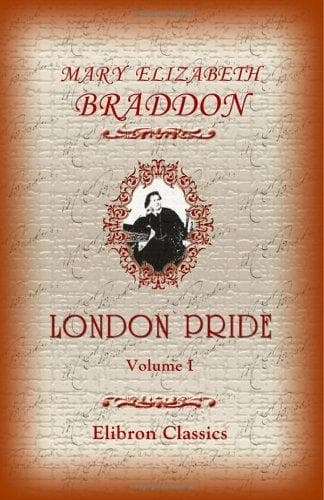
London Pride, Or, When the World Was YoungerBraddon, M. E. (Mary Elizabeth)
History
London Pride, Or, When the World Was Younger
Braddon, M. E. (Mary Elizabeth)
Great Britain -- History -- Charles II, 1660-1685 -- Fiction; London (England) -- Fiction
“Himself the vainest of men, ’tis scarce wonderful that he takes vanity
to be the mainspring that moves the human species,” said De Malfort,
when some one had found fault with the Duke’s analysis.
“Oh, now we shall hear nothing but stale Rochefoucauldisms, sneers at
love and friendship, disparagement of our ill-used sex! Where has my
grave husband been, I wonder?” said Hyacinth. “Upon my honour, Fareham,
your brow looks as sombre as if it were burdened with the care of the
nation.”
“I have been with one who has to carry the greater part of that burden,
my lady, and my spirits may have caught some touch of his uneasiness.”
“You have been prosing with that pragmatical personage at Dunkirk—nay,
I beg the Lord Chancellor’s pardon, Clarendon House. Are not his
marbles and tapestries much finer than ours? And yet he began life as a
sneaking lawyer, the younger son of a small Wiltshire squire——”
“Lady Fareham, you allow your tongue too much licence——”
“Nay, I speak but the common feeling. Everybody is tired of a Minister
who is a hundred years behind the age. He should have lived under
Elizabeth.”
“A pretty woman should never talk politics, Hyacinth.”
“Of what else can I talk when the theatres are closed, and you deny me
the privilege of seeing the last comedy performed at Whitehall? Is it
not rank tyranny in his lordship, Lady Sarah?” turning to one of her
intimates, a lady who had been a beauty at the court of Henrietta Maria
in the beginning of the troubles, and who from old habit still thought
herself lovely and beloved. “I appeal to your ladyship’s common sense.
Is it not monstrous to deprive me of the only real diversion in the
town? I was not allowed to enter a theatre at all last year, except
when his favourite Shakespeare or Fletcher was acted, and that was but
a dozen times, I believe.”
“Oh, hang Shakespeare!” cried a gentleman whose periwig occupied nearly
as much space against the blue of a vernal sky as all the rest of his
dapper little person. “Gud, my lord, it is vastly old-fashioned in your
lordship to taste Shakespeare!” protested Sir Ralph Masaroon, shaking a
cloud of pulvilio out of his cataract of curls. “There was a pretty
enough play concocted t’other day out of two of his—a tragedy and
comedy—_Measure for Measure_ and _Much Ado about Nothing_, the
interstices filled in with the utmost ingenuity. But Shakespeare
unadulterated—faugh!”
“I am a fantastical person, perhaps, Sir Ralph; but I would rather my
wife saw ten of Shakespeare’s plays—in spite of their occasional
coarseness—than one of your modern comedies.”
“I should revolt against such tyranny,” said Lady Sarah. “I have always
appreciated Shakespeare, but I adore a witty comedy, and I never
allowed my husband to dictate to me on a question of taste.”
“Plays which her Majesty patronises can scarcely be unfit entertainment
for her subjects,” remarked another lady.
Public-domain text, read in full here on John Shaqi.
London Pride, Or, When the World Was Younger — John Shaqi
Reviews
Reviews
No reviews yet
Be the first to share your thoughts on this work.
Elsewhere in the archive
Join the Discussion
Join the discussion
Sign in to leave a comment or review.
Sign InorCreate an account