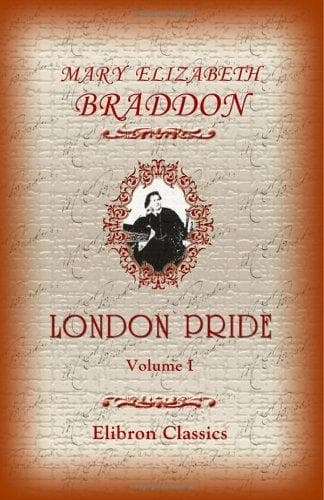
London Pride, Or, When the World Was YoungerBraddon, M. E. (Mary Elizabeth)
History
London Pride, Or, When the World Was Younger
Braddon, M. E. (Mary Elizabeth)
Great Britain -- History -- Charles II, 1660-1685 -- Fiction; London (England) -- Fiction
The company fell back from the ghostly troop, recoiling till they were
all clustered against the opposite wall, leaving a clear space in front
of the spectres, whence they looked on, shuddering, at the tragedy of
the erring Sister’s fate, repeated in dumb show. The white-robed figure
knelt and grovelled at the feet of those hooded executioners. One
seized and bound her, with strange automatic action, unlike the
movements of living creatures, and another smote the wall with a
pickaxe that made no sound, while the third waited with his trowel and
mortar. It was a gruesome sight to those who knew the story—a gruesome,
yet an enjoyable spectacle; since, as Lady Sarah’s friends had not had
the pleasure of knowing the sinning Sister in the flesh, they watched
this ghostly representation of her suffering with as keen an interest
as they would have felt had they been privileged to see Claud Duval
swing at Tyburn.
The person most terrified by this ghostly show was the only one who had
the hardihood to tackle the performers. This was Mr. Dubbin, who sat on
the ground watching the shadowy figures, sobered by fear, and his
shrewd city senses gradually returning to a brain bemused by Burgundy.
“Look at her boots!” he cried suddenly, scrambling to his feet, and
pointing to the nun, who, in sprawling and writhing at the feet of her
executioner, had revealed more leg and foot than were consistent with
her spectral whiteness. “She wears yaller boots, as substantial as any
shoe leather among the company. I’ll swear to them yaller boots.”
A chorus of laughter followed this attack—laughter which found a
smothered echo among the ghosts. The spell was broken; disillusion
followed the exquisite thrill of fear; and all Lady Sarah’s male
visitors made a rush upon the guilty nun. The loose white robe was
stripped off, and little Jerry Spavinger, gentleman jock, famous on the
Heath, and at Doncaster, stood revealed, in his shirt and breeches, and
those light riding-boots which he rarely exchanged for a more courtly
chaussure.
The monks, hustled out of their disguise, were Rochester, Masaroon, and
Lady Sarah’s young brother, George Saddington.
“From my Lord Rochester I expect nothing but pot-house buffoonery; but
I take it vastly ill on your part, George, to join in making me a
laughing-stock,” remonstrated Lady Sarah.
“Indeed, sister, you have to thank his light-headed lordship for giving
a spirited end to your assembly. Could you conceive how preposterous
you and your friends looked sitting against the walls, mute as
stockfish, and suggesting nothing but a Quaker’s meeting, you would
make us your lowest curtsy, and thank us kindly for having helped you
out of a dilemma.”
Lady Sarah, who was too much of a woman of the world to quarrel
seriously with a Court favourite, furled the fan with which she had
been cooling her indignation, and tapped young Wilmot playfully on that
oval cheek where the beard had scarce begun to grow.
Public-domain text, read in full here on John Shaqi.
Reviews
Reviews
No reviews yet
Be the first to share your thoughts on this work.
Elsewhere in the archive
Join the Discussion
Join the discussion
Sign in to leave a comment or review.
Sign InorCreate an account