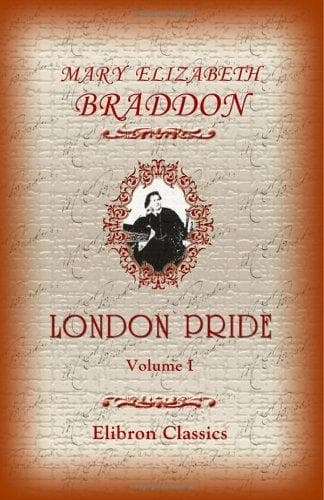
London Pride, Or, When the World Was YoungerBraddon, M. E. (Mary Elizabeth)
History
London Pride, Or, When the World Was Younger
Braddon, M. E. (Mary Elizabeth)
Great Britain -- History -- Charles II, 1660-1685 -- Fiction; London (England) -- Fiction
“You can jeer at that poor lady’s poetry, yet take pleasure in such
balderdash as Hudibras!”
“I love wit, dearest; though I am not witty. But as for your Princesse
de Cleves, I find her ineffably dull.”
“That is because you do not take the trouble to discover for whom the
characters are meant. You lack the key to the imbroglio,” said his
wife, with a superior air.
“I do not care for a book that is a series of enigmas. Don Quixote
needs no such guess-work. Shakespeare’s characters are painted not from
the petty models of yesterday and to-day, but from mankind in every age
and every climate. Molière’s and Calderon’s personages stand on as
solid a basis. In less than half a century your ‘Grand Cyrus’ will be
insufferable jargon.”
“Not more so than your _Hamlet_ or _Othello_. Shakespeare was but kept
in fashion during the late King’s reign because his Majesty loved
him—and will soon be forgotten, now that we have so many gayer and
brisker dramatists.”
“Whoever quotes Shakespeare, nowadays?” asked Lady Sarah Tewkesbury,
who had been showing a rustic niece the beauties of the river, as seen
from Fareham House. “Even Mr. Taylor, whose sermons bristle with
elegant allusions, never points one of his passionate climaxes with a
Shakespearian line. And yet there are some very fine lines in _Hamlet_
and _Macbeth_, which would scarce sound amiss from the pulpit,” added
her ladyship, condescendingly. “I have read all the plays, some of them
twice over. And I doubt that though Shakespeare cannot hold the stage
in our more enlightened age, and will be less and less acted as the
town grows more refined, his works will always be tasted by scholars;
among whom, in my modest way, I dare reckon myself.”
Lord Fareham left London on horseback, with but one servant, in the
early August dawn, before the rest of the household were stirring.
Hyacinth lay nearly as late of a morning as Henrietta Maria, whom
Charles used sometimes to reproach for not being up in time for the
noonday office at her own chapel. Lady Fareham had not Portuguese
Catherine’s fervour, who was often at Mass at seven o’clock; but she
did usually contrive to be present at High Mass at the Queen’s chapel;
and this was the beginning of her day. By that time Angela and her
niece and nephew had spent hours on the river, or in the meadows at
Chiswick, or on Putney Heath, ever glad to escape from the great
overgrown city, which was now licking up every stretch of green sward,
and every flowery hedgerow west of St. James’s Street. Soon there would
be no country between the Haymarket and “The Pillars of Hercules.”
Public-domain text, read in full here on John Shaqi.
Reviews
Reviews
No reviews yet
Be the first to share your thoughts on this work.
Elsewhere in the archive
Join the Discussion
Join the discussion
Sign in to leave a comment or review.
Sign InorCreate an account