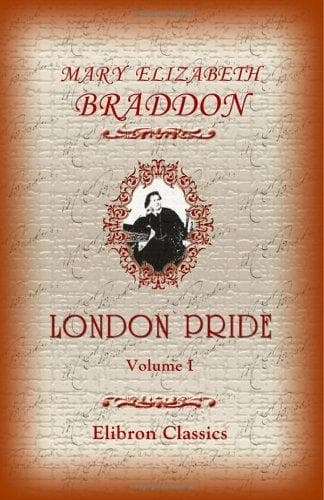
London Pride, Or, When the World Was YoungerBraddon, M. E. (Mary Elizabeth)
History
London Pride, Or, When the World Was Younger
Braddon, M. E. (Mary Elizabeth)
Great Britain -- History -- Charles II, 1660-1685 -- Fiction; London (England) -- Fiction
Without deliberate disobedience to her husband, Lady Fareham made the
best use of her time during his absence in Paris. The public theatres
had not yet re-opened after the horror of the plague. Whitehall was a
desert, the King and his chief following being at Tunbridge. It was the
dullest season of the year, and the recrudescence of the contagion in
the low-lying towns along the Thames—Deptford, Greenwich, and the
neighbourhood—together with some isolated cases in London, made people
more serious than usual, despite of the so-called victory over the
Dutch, which, although a mixed benefit, was celebrated piously by a day
of General Thanksgiving.
Hyacinth, disgusted at the dulness of the town, was for ordering her
coaches and retiring to Chilton.
“It is mortal dull at the Abbey,” she said, “but at least we have the
hawks, and breezy hills to ride over, instead of this sickly city
atmosphere, which to my nostrils smells of the pestilence.”
Henri de Malfort argued against such a retreat.
“It were a deliberate suicide,” he said. “London, when everybody has
left—all the bodies we count worthy to live, _par exemple_—is a more
delightful place than you can imagine. There are a host of vulgar
amusements which you would not dare to visit when your friends are in
town; and which are ten times as amusing as the pleasures you know by
heart. Have you ever been to the Bear Garden? I’ll warrant you no,
though ’tis but across the river at Bankside. We’ll go there this
afternoon, if you like, and see how the common people taste life. Then
there are the gardens at Islington. There are mountebanks, and
palmists, and fortune-tellers, who will frighten you out of your wits
for a shilling. There’s a man at Clerkenwell, a jeweller’s journeyman
from Venice, who pretends to practise the transmutation of metals, and
to make gold. He squeezed hundreds out of that old miser Denham, who
was afraid to have the law of him for imposture, lest all London should
laugh at his own credulity and applaud the cheat. And you have not seen
the Italian puppet-play, which is vastly entertaining. I could find you
novelty and amusement for a month.”
“Find anything new, even if it fail to amuse me. I am sick of
everything I know.”
“And then there is our midnight party at Millbank, the ghost-party, at
which you are to frighten your dearest friends out of their poor little
wits.”
“Most of my dearest friends are in the country.”
“Nay, there is Lady Lucretia Topham, whom I know you hate; and Lady
Sarah and the Dubbins are still in Covent Garden.”
“I will have no Dubbin—a toping wretch—and she is a too incongruous
mixture, with her Edinburgh lingo and her Whitehall arrogance. Besides,
the whole notion of a mock ghost was vulgarised by Wilmot’s foolery,
who ought to have been born a saltimbanque, and spent his life in a
fair. No, I have abandoned the scheme.”
Public-domain text, read in full here on John Shaqi.
Reviews
Reviews
No reviews yet
Be the first to share your thoughts on this work.
Elsewhere in the archive
Join the Discussion
Join the discussion
Sign in to leave a comment or review.
Sign InorCreate an account