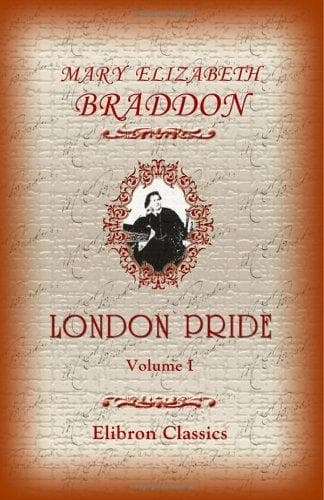
London Pride, Or, When the World Was YoungerBraddon, M. E. (Mary Elizabeth)
History
London Pride, Or, When the World Was Younger
Braddon, M. E. (Mary Elizabeth)
Great Britain -- History -- Charles II, 1660-1685 -- Fiction; London (England) -- Fiction
The company melted out of the room; all but Fareham, who watched Lady
Castlemaine as she stood by the hearth in an attitude of hopeless
self-forgetfulness, leaning against the lofty sculptured chimney-piece,
one slender foot in gold-embroidered slipper and transparent stocking
poised on the brazen fender, and her proud eyelids lowered as if there
was nothing in this world worth looking at but the pile of ship’s
timber, burning with many-coloured flames upon the silver andirons.
In spite of that sullen downward gaze she was conscious of Fareham’s
lingering.
“Why do you stay, my lord?” she asked, without looking up. “If your
purse is heavy there are friends of mine yonder who will lighten it for
you, fairly or foully. I have never made up my mind how far a gentleman
may be a rogue with impunity. If you don’t love losing money you had
best eat a good supper and begone.”
“I thank you, madam. I am more in the mood for cards than for
feasting.”
She did not answer him, but clasped her hands suddenly before her face
and gave a heart-breaking sigh. Fareham paused on the threshold of the
gallery, watching her, and then went slowly back, bent down to take the
hand that had dropped at her side, and pressed his lips upon it,
silently, respectfully, with a kind of homage that had become strange
of late years to Barbara Palmer. Adorers she had and to spare,
toadeaters and flatterers, a regiment of mercenaries; but these all
wanted something of her—kisses, smiles, influence, money. Disinterested
respect was new.
“I thought you were a Puritan, Lord Fareham.”
“I am a man; and I know what it is to suffer the hell-fire of
jealousy.”
“Jealousy, yes! I never was good at hiding my feelings. He treats me
shamefully. Come, now, you take me for an abandoned profligate woman, a
callous wanton. That is what the world takes me for; and, perhaps, I
have deserved no better of the world. But whatever I am ’twas he made
me so. If he had been true, I could have been constant. It is the
insolence of abandonment that stings; the careless slights, scarce
conscious that he wounds. Before the eyes of the world, too, before
wretches that grin and whisper, and prophesy the day when my pride
shall be in the dust. It is treatment such as this that makes women
desperate; and if we cannot keep him we love, we make believe to love
some one else, and flaunt our fancy in the deceiver’s face. Do you
think I cared for Buckingham, with his heart of ice; or for such a
snipe as Jermyn; or for a low-born rope-dancer? No, Fareham; there has
been more of rage and hate than of passion in my caprices. And he is
with Frances Stewart to-night. She sets up for a model of chastity, and
is to marry Richmond next month. But we know, Fareham, we know. Women
who ride in glass coaches should not throw stones. I will have Charles
at my feet again. I will have my foot upon his neck again. I cannot use
him too ill for the pain he gives me. There, go—go! Why did you tempt
me to lay my heart bare?”
Public-domain text, read in full here on John Shaqi.
Reviews
Reviews
No reviews yet
Be the first to share your thoughts on this work.
Elsewhere in the archive
Join the Discussion
Join the discussion
Sign in to leave a comment or review.
Sign InorCreate an account