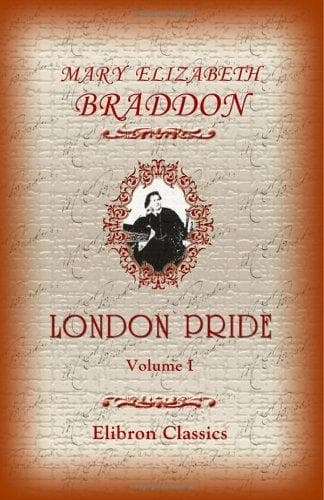
London Pride, Or, When the World Was YoungerBraddon, M. E. (Mary Elizabeth)
History
London Pride, Or, When the World Was Younger
Braddon, M. E. (Mary Elizabeth)
Great Britain -- History -- Charles II, 1660-1685 -- Fiction; London (England) -- Fiction
It was decided after a brief parley that the principals only should
fight. The quarrel was private. The seconds placed their men on a piece
of level turf, five paces apart. They were bare-headed, and without
coat or vest, the lace ruffles of their shirt-sleeves rolled back to
the elbow, their naked arms ghastly white, their faces suggesting ghost
or devil as the spectral moonlight or the flame of the flambeaux shone
upon them.
“You mean business, so we may sink the parade of the fencing saloon,”
said Dangerfield. “Advance, gentlemen.”
“A pity,” murmured Masaroon, “there is nothing prettier than the salute
_à la Française_.”
Dangerfield handed the men their swords. They were nearly similar in
fashion, both flat-grooved blades, with needle points, and no cutting
edge, furnished with shell-guards and cross-bars in the Italian style,
and were about of a length.
The word was given, and the business of engagement proceeded slowly and
warily, for a few moments that seemed minutes; and then the blades were
firmly joined in carte, and a series of rapid feints began, De Malfort
having a slight advantage in the neatness of his circles, and the
swiftness of his wrist play. But in these preliminary lounges and
parries, he soon found he needed all his skill to dodge his opponent’s
point; for Fareham’s blade followed his own, steadily and strongly,
through every turn.
De Malfort had begun the fight with an insolent smile upon his lips,
the smile of a man who believes himself invincible, while Fareham’s
countenance never changed from the black anger that had darkened it all
that night. It was a face that meant death. A man who had never been a
duellist, who had raised his voice sternly against the practice of
duelling, stood there intent upon bloodshed. There could be no mistake
as to his purpose. The quarrel was an artificial quarrel—the object was
murder.
Public-domain text, read in full here on John Shaqi.
Reviews
Reviews
No reviews yet
Be the first to share your thoughts on this work.
Elsewhere in the archive
Join the Discussion
Join the discussion
Sign in to leave a comment or review.
Sign InorCreate an account