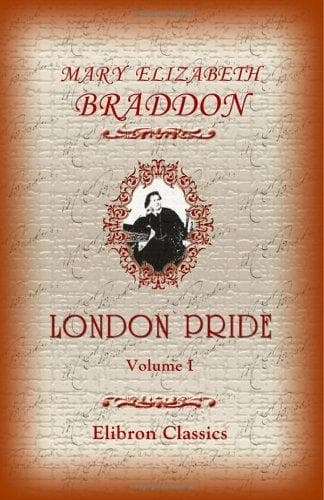
London Pride, Or, When the World Was YoungerBraddon, M. E. (Mary Elizabeth)
History
London Pride, Or, When the World Was Younger
Braddon, M. E. (Mary Elizabeth)
Great Britain -- History -- Charles II, 1660-1685 -- Fiction; London (England) -- Fiction
“Why, you can stand with the fops in the pit, and you can buy us some
China oranges. I heard Lady Sarah tell my mother that the new little
actress with the pretty feet was once an orange-girl, who lived with
Lord Buckhurst. Why did he have an orange-girl to live with him? He
must be vastly fond of oranges. I should love to sell oranges in the
pit, if I could be an actress afterwards. I would rather be an actress
than a duchess. Mademoiselle taught me Chiméne’s tirades in Corneille’s
_Cid_. I learn quicker than any pupil she ever had. Monsieur de Malfort
once said I was a born actress,” pursued Papillon, as they walked to
the house.
_Philaster!_ That story of unhappy love—so pure, patient, melancholy,
disinterested. How often Angela had hung over the page, in the solitude
of her own chamber! And to hear the lines spoken to-day, when a tempest
of emotion had been raised in her breast, with Fareham by her side; to
meet his glances at this or that moment of the play, when the devoted
girl was revealing the secret of her passionate heart. Yet never was
love freer from taint of sin, and the end of the play was in no wise
tragic. That pure affection was encouraged and sanctified by the happy
bride. Bellario was not to be banished, but sheltered.
Alas! yes; but this was love unreturned. There was no answering warmth
on Philaster’s part, no fire of passion to scathe and destroy; only a
gentle gratitude for the girl’s devotion—a brother’s, not a lover’s
regard.
She found Fareham and her sister in the hall, ready to step into the
coach.
“I saw the name of your favourite play on the posts as I walked home,”
he said; “and as Hyacinth is always teasing me for denying her the
play-house, I thought this was a good opportunity for pleasing you
both.”
“You would have pleased me more if you had offered me the chance of
seeing a new comedy,” his wife retorted, pettishly.
“Ah, dearest, let us not resume an old quarrel. The play-wrights of
Elizabeth’s age were poets and gentlemen. The men who write for us are
blackguards and empty-headed fops. We have novelty, which is all most
of us want, a hundred new plays in a year, of which scarce one will be
remembered after the year is out.”
“Who wants to remember? The highest merit in a play is that it should
be a reflection of to-day; and who minds if it be stale to-morrow? To
hold the mirror up to nature, doesn’t your Shakespeare say? And what
more transient than the image in a glass? A comedy should be like one’s
hat or one’s gown, the top of the mode to-day, and cast off and
forgotten, in a week.”
“That is what our fine gentlemen think; who are satisfied if their wit
gets three days’ acceptance, and some substantial compliment from the
patron to whom they dedicate their trash.”
Public-domain text, read in full here on John Shaqi.
Reviews
Reviews
No reviews yet
Be the first to share your thoughts on this work.
Elsewhere in the archive
Join the Discussion
Join the discussion
Sign in to leave a comment or review.
Sign InorCreate an account