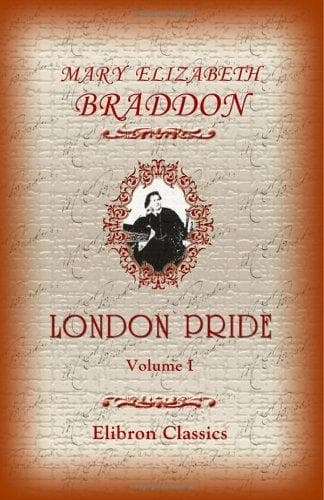
London Pride, Or, When the World Was YoungerBraddon, M. E. (Mary Elizabeth)
History
London Pride, Or, When the World Was Younger
Braddon, M. E. (Mary Elizabeth)
Great Britain -- History -- Charles II, 1660-1685 -- Fiction; London (England) -- Fiction
Denzil was of a temper as thoughtful, but his studies had taken a
different direction. He was not even by taste or apprehension a poet.
Had he been called upon to criticise his tutor’s compositions, he
might, like Johnson, have objected to the metaphoric turns of Lycidas,
and have missed the melody of lines as musical as the nightingale. In
that great poem of which he had been privileged to transcribe many of
the finest passages from the lips of the poet, he admired rather the
heroic patience of the blind author than the splendour of the verse. He
was more impressed by the schoolmaster’s learning than by that
God-given genius which lifted that one Englishman above every other of
his age and country. No, he was eminently prosaic, had sucked prose and
plain-thinking from his mother’s breast; but he was not the less an
agreeable companion for a girl upon whose youth an unnatural solitude
had begun to weigh heavily.
All that one mind can impart to another of a widely different fibre,
Denzil had learnt from Milton in that most impressionable period of
boyhood which he had spent in the small house in Holborn, whose back
rooms looked out over the verdant spaces of Lincoln’s Inn Fields, where
Lord Newcastle’s palace had not yet begun to rise from its foundations,
and where the singing birds had not been scared away by the growth of
the town. A theatre now stood where the boy and a fellow-scholar had
played trap and ball, and the stately houses of Queen Street hard by
were alive with rank and fashion.
In addition to the classical curriculum which Milton had taught with
the solemn earnestness of one in whom learning is a religion, Denzil
had acquired a store of miscellaneous knowledge from the great
Republican; and most interesting among these casual instructions had
been the close acquaintance with nature gained in the course of many a
rustic ramble in the country lanes beyond Gray’s Inn, or sauntering
eastward along the banks of the limpid Lee, or in the undulating
meadows beside Sir Hugh Middleton’s river. Mixed with plain facts about
plant or flower, animal or insect, Milton’s memory was stored with the
quaint absurdities of the Hermetic philosophy, that curious mixture of
deep-reaching theories and old women’s superstitions, the experience of
the peasant transmuted by the imagination of the adept. Sound and
practical as the poet had ever shown himself—save where passion got the
upper hand of common sense, as in his advocacy of divorce—he was yet
not entirely free from a leaning to Baconian superstitions, and may,
with Gesner, have believed that the pickerel weed could engender pike,
and that frogs could turn to slime in winter, and become frogs again in
spring. Whatever rags of old-world fatuity may have lingered in that
strong brain, he had been not the less a delightful teacher, and had
imparted an ardent love of nature to his little family of pupils in
that peripatetic school between hawthorn hedges or in the open fields
by the Lee.
Public-domain text, read in full here on John Shaqi.
Reviews
Reviews
No reviews yet
Be the first to share your thoughts on this work.
Elsewhere in the archive
Join the Discussion
Join the discussion
Sign in to leave a comment or review.
Sign InorCreate an account