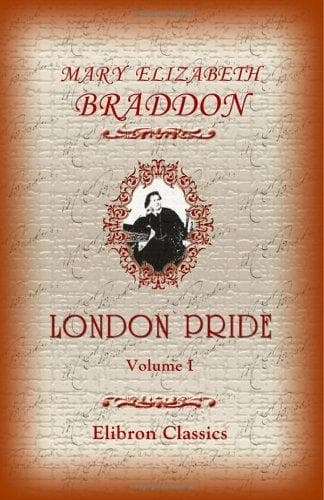
London Pride, Or, When the World Was YoungerBraddon, M. E. (Mary Elizabeth)
History
London Pride, Or, When the World Was Younger
Braddon, M. E. (Mary Elizabeth)
Great Britain -- History -- Charles II, 1660-1685 -- Fiction; London (England) -- Fiction
Before May was ended, she knew old Izaak almost as well as Denzil, and
had learnt to throw a fly, and to choose the likeliest spot and the
happiest hour of the day for a good trout; had learnt to watch the
clouds and cloud-shadows with an angler’s keen interest; and had amused
herself with the manufacture of an artificial minnow, upon Walton’s
recipe, devoting careful labour and all the resources of her embroidery
basket—silks and silver thread—to perfecting the delicate model, which,
when completed, she presented smilingly to Denzil, who was strangely
moved by so childish a toy, and had some difficulty in suppressing his
emotion as he held the glistening silken fish in his hands, and thought
how her tapering fingers had caressed it, and how much of her very self
seemed, as he watched her, to have been enwrought with the fabric. So
poor, so trivial a thing; but her first gift! If she had tossed him a
flower, plucked that moment, he would have treasured it all his life;
but this, which had cost her so much careful work, was far more than
any casual blossom. Something of the magnetism of her mind had passed
into the silver thread drawn so daintily through her rosy
fingers—something of the soft light in her eyes had mixed with the
blended colours of the silk. Foolish fancies these, but in the gravest
man’s love there is a vein of folly.
Sometimes they rode with Sir John, and in this way explored the
neighbourhood, which was rich in historical associations—some of the
remote past, as when King John kept Christmas at Brill; but chiefly of
those troubled times through which Sir John Kirkland had lived, an
active participator in that deadly drama. He showed them the site of
the garrison at Brill, and trod every foot of the earthworks to
demonstrate how the hill had been fortified. He had commanded in the
defence against Hampden and his greencoats—that regiment of foot raised
in his pastoral shire, whose standard bore on one side the watchword of
the Parliament, “God with us,” and on the other Hampden’s own device,
“_Vestigia nulla retrorsum_.”
“’Twas a legend to frighten some of us, who had no Latin,” said Sir
John; “but we put his bumpkin greencoats to the rout, and trampled that
insolent flag in the mire.”
Public-domain text, read in full here on John Shaqi.
Reviews
Reviews
No reviews yet
Be the first to share your thoughts on this work.
Elsewhere in the archive
Join the Discussion
Join the discussion
Sign in to leave a comment or review.
Sign InorCreate an account