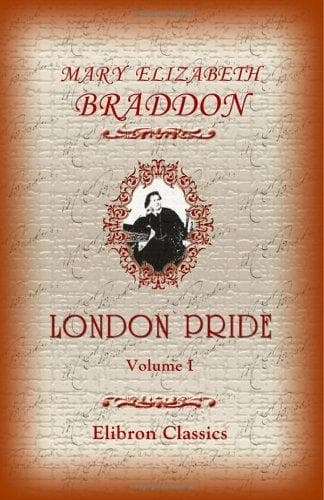
London Pride, Or, When the World Was YoungerBraddon, M. E. (Mary Elizabeth)
History
London Pride, Or, When the World Was Younger
Braddon, M. E. (Mary Elizabeth)
Great Britain -- History -- Charles II, 1660-1685 -- Fiction; London (England) -- Fiction
“Ah, what a history that was!” he exclaimed. “His mother trained him as
if with a foreknowledge of that star-like ascendency. He was schooled
to shine and dazzle, to excel all compeers in the graces men and women
admire. I doubt she never thought of the mind inside him, or cared
whether he had a heart or a lump of marble behind his waist-band. He
was taught neither to think nor to pity—only to shine; to be quick with
his tongue in half a dozen languages, with his sword after half a dozen
modes of fence. He could kill his man in the French, or the Italian, or
the Spanish manner. He was cosmopolitan in the knowledge of evil. He
had every device that can make a man brilliant and dangerous. He
mounted every rung of the ladder, leaping from step to step. He
ascended, swift as a shooting star, from plain country gentleman to the
level of princes. And he expired with an ejaculation, astonished to
find himself mortal, slain in a moment by the thrust of a ten-penny
knife. I remember as if it were yesterday how men looked and spoke when
the news came to London, and how some said this murder would be the
saving of King Charles. I know of one man at least who was glad.”
“Who was he, sir?” asked Denzil.
“He who had the greatest mind among Englishmen—Thomas Wentworth.
Buckingham had held him at a distance from the King, and his strong
passionate temper was seething with indignation at being kept aloof by
that silken sybarite—an impotent General, a fatal counsellor. After the
Favourite’s death there came a time of peace and plenty. The pestilence
had passed, the war was over. Charles was happy with his Henriette and
their lovely children. Wentworth was in Ireland. The Parliament House
stood still and empty, doors shut, swallows building under the eaves. I
look back, and those placid years melt into each other like one long
summer. And then, again, as ’twere yesterday, I hear Hampden’s drums
and fifes in the lanes, and see the rebels’ flag with that hateful
legend, ‘Vestigia nulla retrorsum,’ and Buckinghamshire peasants are
under arms, and the King and his people have begun to hate and fear
each other.”
“None foresaw that the war would last so long or end in murder, I
doubt, sir,” said Angela.
“Nay, child; we who were loyal thought to see that rabble withered by
the breath of kingly nostrils. A word should have brought them to the
dust.”
“There might be so easy a victory, perhaps, sir, from a King who knew
how to speak the right word at the right moment, how to comply
graciously with a just demand, and how to be firm in a righteous
denial,” replied Denzil; “but with Charles a stammering speech was but
the outward expression of a wavering mind. He was a man who never
listened to an appeal, but always yielded to a threat, were it only
loud enough.”
Public-domain text, read in full here on John Shaqi.
Reviews
Reviews
No reviews yet
Be the first to share your thoughts on this work.
Elsewhere in the archive
Join the Discussion
Join the discussion
Sign in to leave a comment or review.
Sign InorCreate an account