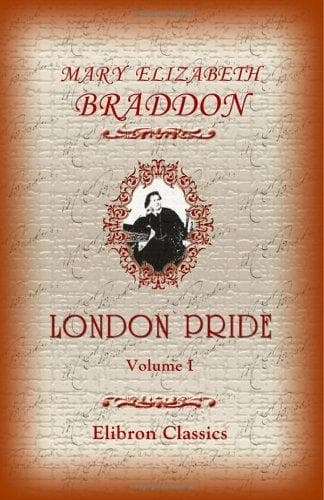
London Pride, Or, When the World Was YoungerBraddon, M. E. (Mary Elizabeth)
History
London Pride, Or, When the World Was Younger
Braddon, M. E. (Mary Elizabeth)
Great Britain -- History -- Charles II, 1660-1685 -- Fiction; London (England) -- Fiction
“Ah, dearest, I am grateful to you for coming. But, alas! you are
looking pale and thin. Heaven forbid that you have been indisposed, and
we in ignorance of your suffering.”
“No, I am well enough, though every one assures me I look ill; which is
but a civil mode of telling me I am growing old and ugly.”
“Nay, Hyacinth, the former we must all become, with time; the latter
you will never be.”
“Your servant, Sir Denzil, has taught you to pay antique compliments.
Well, now we will talk business. I had occasion to send for Lewin—my
toilet was in a horrid state of decay; and then it seemed to me,
knowing your foolish indifference, that even your wedding gown would
not be chosen unless I saw to it. So here is Lewin with Lyons and Genoa
silks of the very latest patterns. She has but just come from Paris,
and is full of Parisian modes and Court scandals. The King posted off
to Versailles directly after his mother’s death, and has not returned
to the Louvre since. He amuses himself by spending millions on
building, and making passionate love to Mademoiselle la Vallière, who
encourages him by pretending an excessive modesty, and exaggerates
every favour by penitential tears. I doubt his attachment to so
melancholy a mistress will hardly last a lifetime. She is not
beautiful; she has a halting gait; and she is no more virtuous than any
other young woman who makes a show of resistance to enhance the merit
of her surrender.”
Hyacinth prattled all the way to the parlour, Mrs. Lewin and the
waiting-woman following, laden with parcels.
“Queer, dear old hovel!” she exclaimed, sinking languidly upon a
tabouret, and fanning herself exhaustedly, while the mantua-maker
opened her boxes, and laid out her sample breadths of richly decorated
brocade, or silver and gold enwrought satin. “How well I remember being
whipped over my horn-book in this very room! And there is the bowling
green where I used to race with the Italian greyhound my grandmother
brought me from Paris. I look back, and it seems a dream of some other
child running about in the sunshine. It is so hard to believe that
joyous little being—who knew not the meaning of heart-ache—was I.”
“Why that sigh, sister? Surely none ever had less cause for heart-ache
than you?”
“Have I not cause? Not when my glass tells me youth is gone, and beauty
is waning? Not when there is no one in this wide world who cares a
straw whether I am handsome or hideous? I would as lief be dead as
despised and neglected.”
“Sorella mia, questa donna ti ascolta,” murmured Angela; “come and look
at the old gardens, sister, while Mrs. Lewin spreads out her wares. And
pray consider, madam,” turning to the mantua-maker, “that those peacock
purples and gold embroideries have no temptations for me. I am marrying
a country gentleman, and am to lead a country life. My gowns must be
such as will not be spoilt by a walk in dusty lanes, or a visit to a
farm-labourer’s cottage.”
Public-domain text, read in full here on John Shaqi.
Reviews
Reviews
No reviews yet
Be the first to share your thoughts on this work.
Elsewhere in the archive
Join the Discussion
Join the discussion
Sign in to leave a comment or review.
Sign InorCreate an account