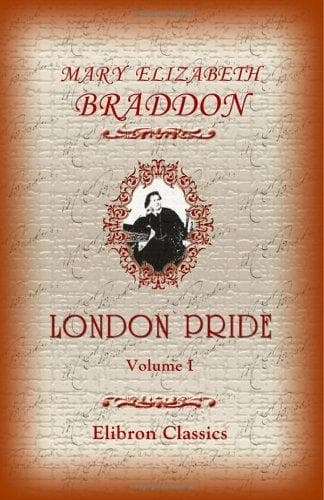
London Pride, Or, When the World Was YoungerBraddon, M. E. (Mary Elizabeth)
History
London Pride, Or, When the World Was Younger
Braddon, M. E. (Mary Elizabeth)
Great Britain -- History -- Charles II, 1660-1685 -- Fiction; London (England) -- Fiction
Why was he so gloomy and so unkind, in an hour when his sympathy should
naturally have been given to her? Was he consumed with sorrow for his
wife’s indisposition, and did anxiety make him silent; or was he angry
with himself for not being as deeply distressed as a husband ought to
be at a wife’s peril? She knew too well how he and Hyacinth had been
growing further apart day by day, till the only link between husband
and wife seemed to be a decent courtesy and subservience to the world’s
opinion.
She recalled that other occasion when they two had made a solitary
journey together, and in as gloomy a silence—that night of the great
fire, when he had flung off his doublet and taken the sculls out of her
hands, and rowed steadily and fast, with his eyes downcast, leaving her
to steer the boat as she would, or trusting to the lateness of the hour
for a clear course. He had seemed to hate her that night just as he
seemed to hate her now, as they rode mile after mile side by side, the
groom following near, now at a fast trot, now galloping along a stretch
of waste grass that bordered the highway, now breathing their horses in
a walk.
In one of those intervals he asked her if she were tired.
“No, no. I have no power to feel anything but anxiety. If you would
only be kinder and tell me more about my sister! I fear you consider
her in danger.”
“Yes, she is in danger. There is no doubt of that.”
“O God! she looked so ill when I saw her last, and she talked so
wildly. I feared she was in a bad way. How soon shall we be at Chilton,
my lord?”
“My lord! Why do you ‘my lord’ me?”
“I can find no other name. We seem to be strangers to-night; but,
indeed, names and ceremonies matter nothing when the mind is in
trouble. How soon shall we reach the Abbey, Fareham?”
“In an hour, at latest, Angela.”
His voice trembled as he spoke her name, and all of force and passion
that could be breathed into a single word was in his utterance. She
flushed at the sound, and looked at him with a sudden fear; but his
countenance might have been wrought-iron, so cold and passionless and
cruelly resolute looked that rough-hewn face in the moonlight.
“I have a fresh horse waiting for you at Thame,” he said. “I will not
have you wearied by riding a tired horse. We are within five minutes of
the inn. Will you rest there for half an hour, and take some
refreshment?”
“Rest, when my sister may be dying! Not a moment more than is needed to
change horses.”
“I have brought Queen Bess, another of your favourites. ’Twas she who
taught you to ride. She will know your voice, and your light hand upon
her bridle.”
They found the Inn wrapped in slumber, like every house or cottage they
had passed; but a lantern shone within an open door in the quadrangle
round which house and stables were built. One of the Fareham grooms was
there, with an ostler to wait upon him, and three horses were brought
out of their stable, ready saddled, as the travellers rode under the
archway into the yard.
Public-domain text, read in full here on John Shaqi.
Reviews
Reviews
No reviews yet
Be the first to share your thoughts on this work.
Elsewhere in the archive
Join the Discussion
Join the discussion
Sign in to leave a comment or review.
Sign InorCreate an account