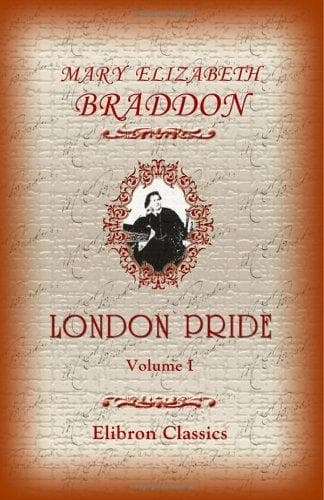
London Pride, Or, When the World Was YoungerBraddon, M. E. (Mary Elizabeth)
History
London Pride, Or, When the World Was Younger
Braddon, M. E. (Mary Elizabeth)
Great Britain -- History -- Charles II, 1660-1685 -- Fiction; London (England) -- Fiction
“At last!” he cried. “Why did you inflict such torturing apprehensions
upon me? This woman has been telling me of the horrors of the streets
where you have been; and I figured you stricken suddenly with this foul
malady, creeping into some deserted alley to expire uncared for, dying
with your head upon a stone, lying there to be carried off by the
dead-cart. You must not leave this house again, save for the coach that
shall fetch you to Oxfordshire to join Hyacinth and her children—and
that coach shall start to-morrow. I am a madman to have let you stay so
long in this infected house.”
“You forget that I am plague-proof,” she answered, throwing off hood
and cloak, and going to his bedside, to the chair in which she had
spent many hours watching by him and praying for him.
No, there was no relapse. He had only been restless and uneasy because
of her absence. The disease was conquered, the pest-spots were healing
fairly, and his nurses had only to contend against the weakness and
depression which seemed but the natural sequence of the malady.
Dr. Hodgkin was satisfied with his patient’s progress. He had written
to Lady Fareham, advising her to send some of her servants with horses
for his lordship’s coach, and to provide for relays of post-horses
between London and Oxfordshire, a matter of easier accomplishment than
it would have been in the earlier summer, when the quality were flying
to the country, and post-horses were at a premium. Now there were but
few people of rank or standing who had the courage to stay in town,
like the Archbishop, who had not left Lambeth, or the stout old Duke of
Albemarle, at the Cockpit, who feared the pestilence no more than he
feared sword or cannon.
Two of his lordship’s lackeys, and his Oxfordshire major-domo and clerk
of the kitchen, arrived a week after Angela’s landing, bringing loving
letters from Hyacinth to her husband and sister. The physician had so
written as not to scare the wife. She had been told that her husband
had been ill, but was in a fair way to recovery, and would post to
Oxfordshire as soon as he was strong enough for the journey, carrying
his sister-in-law with him, and lying at the accustomed inn at High
Wycombe, or perchance resting two nights and spending three days upon
the road.
That was a happy day for Angela when her patient was well enough to
start on his journey. She had been longing to see her sister and the
children, longing still more intensely to escape from the horror of
that house, where death had seemed to lie in ambush behind the tapestry
hangings, and where few of her hours had been free from a great fear.
Even while Fareham was on the high-road to recovery there had been in
her mind the ever-present dread of a relapse. She rejoiced with fear
and trembling, and was almost afraid to believe physician and nurse
when they assured her that all danger was over.
Public-domain text, read in full here on John Shaqi.
Reviews
Reviews
No reviews yet
Be the first to share your thoughts on this work.
Elsewhere in the archive
Join the Discussion
Join the discussion
Sign in to leave a comment or review.
Sign InorCreate an account