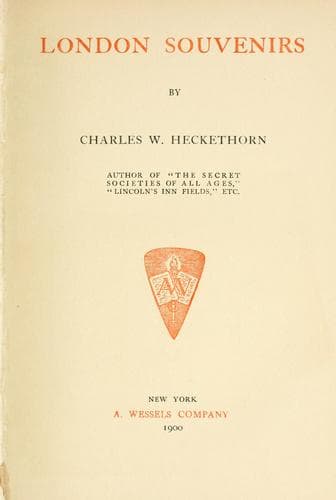
London (England) -- Description and travel; London (England) -- History -- 1800-1950
Bridewell Bridge, the last over the Fleet before its entering the
Thames, and the last built (in the sixteenth century), was at first a
timber bridge, between Blackfriars and the House of Bridewell, on the
site of the Castle Mountfiquet, which originally stood there. In 1708,
or thereabouts, it was replaced by one of stone, much higher than the
street, being ascended by fourteen steps. It was for foot passengers
only. It was pulled down in 1765.
We may now conclude our account of the Fleet with a few statements
concerning the vicissitudes it passed through.
A great many antiquities—British, Saxon, and Roman—have been found in
the bed of this river, such as coins of silver, copper, and brass, but
none of gold; lares, spur rowels, keys, daggers, seals, medals, vases,
and urns. An anchor, three feet ten inches in height, encrusted with
rust and pebbles—a sketch of which is given in the October number of the
_Gentleman’s Magazine_, 1843—is said to have been discovered near the
site of Holborn Bridge, which may be genuine, as ships are known to have
ascended so far up the river in the fourteenth century. But early in
that century already the river was choked up ’by the filth of the
tanners and others, and by the raising of wharves, and especially by a
diversion of the water in the first year of King John (1200) by them of
the New Temple for their mills without Baynard’s Castle, and by other
impediments, the course was decayed, and ships could not enter as they
were used.’ Upon this complaint of Henry Lacy, Earl of Lincoln, the
river was cleansed, the mills removed, and other means taken for its
preservation; but it was not brought to its former depth and width, and
so was soon filled with mud again. The scouring of the river seems to
have been necessary every thirty or forty years, at a great expense to
the City. We find that it was so cleansed in 1502, and once more
rendered navigable for large barges, but the dwellers on its banks would
continue to make it the receptacle of all the refuse, and the wharves
built on its banks proved unsuccessful, as vessels could not approach
them. Consequently, in 1733 the City of London, seeing that all
navigation had ceased, and that the ditch, as it was then called, was a
danger to the public on account of its unsanitary state, and because
persons had fallen in and been suffocated in the mud, began covering it
in, commencing with the portion from Fleet Bridge to Holborn Bridge, and
the new Fleet Market was erected on the site in 1737. The part from
Fleet Street to the Thames was covered in when the approaches to
Blackfriars were completed between 1760 and 1768. One stubborn citizen,
however, would not surrender a small filthy dock; a barber, from
Bromley, in Kent, was, in 1763, found in it standing upright and frozen
to death.
Public-domain text, read in full here on John Shaqi.
Reviews
Reviews
No reviews yet
Be the first to share your thoughts on this work.
Elsewhere in the archive
Join the Discussion
Join the discussion
Sign in to leave a comment or review.
Sign InorCreate an account