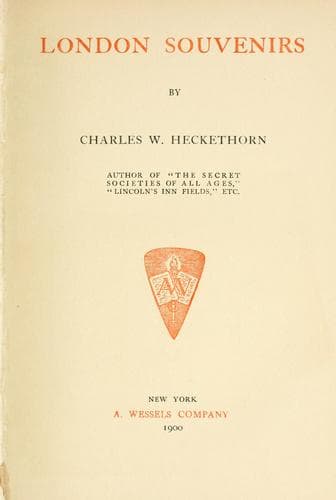
London (England) -- Description and travel; London (England) -- History -- 1800-1950
1631. Item, paid towards the repairs of Brentford
Bridge and of Knightsbridge, etc. . . . . . . 24 7 10
The Westbourne was occasionally a source of inconvenience and even
danger to the inhabitants of Knightsbridge. After heavy rains or in
sudden thaws it overflowed. On September 1, 1768, it did so, and did
great damage, almost undermining some of the houses; and in January,
1809, it overflowed again, and covered the neighbouring fields so deeply
that they resembled a lake, and passengers were for several days rowed
from Chelsea to Westminster by Thames boatmen.
On the site now covered by St. George’s Row, Pimlico, there stood in the
middle of the last century a house of entertainment known as ’Jenny’s
Whim.’ A long wooden bridge over one of the many arms of the Westbourne
led up to the house. The present Ebury Bridge over the Grosvenor Canal,
which this river-branch has become, occupies the site of this old
bridge. ’Jenny’s Whim’ had trim gardens, alcoves, ponds, and facilities
for duck-hunting; in the gardens were recesses, where, by treading on a
spring, up started different figures, some ugly enough to frighten
people, a harlequin, a Mother Shipton, or some terrible animal. Horace
Walpole occasionally alludes to ’Jenny’s Whim’; in one of his letters to
Montagu, he says: ’Here (at Vauxhall) we picked up Lord Granby, arrived
very drunk from Jenny’s Whim.’ Towards the beginning of this century
’Jenny’s Whim’ began to decline; at last it sank down to the condition
of a beershop, and in 1804 it was finally closed. The origin of the
name is doubtful. Davis, the historian of Knightsbridge, accepts the
account given him by an old inhabitant, that it was so called from its
first landlady, who directed the gardens to be laid out in so fantastic
a manner as to cause the noun to be added to her own Christian name.
Other reports say that the place was established by a celebrated
pyrotechnist in the reign of George I.; but that does not account for
the name.
Like other London rivers, the Westbourne in the end became a sewer; it
was gradually covered up; of the two chief branches by which it reached
the Thames, the eastern one became the Grosvenor Canal, and the western
the Ranelagh Sewer. The canal was crossed by several other bridges,
Stone Bridge being one of them.
We stated above that the Westbourne formed the western boundary of
Chelsea; its eastern boundary was also a river, or rather rivulet, which
it appears never even had a name, though in one old map I find it called
Bridge Creek. It rose in Wormwood Scrubs, skirted the West London and
Westminster Cemetery, and entered the Thames west of Battersea Bridge,
where, in fact, there is still a creek going some distance inland. The
rest of the stream has been absorbed by the West Kensington Railway. No
vestige of it remains, and it has no history.
Brook Green took its name from a brook which once rose near Shepherd’s
Bush, but it has no records.
Public-domain text, read in full here on John Shaqi.
Reviews
Reviews
No reviews yet
Be the first to share your thoughts on this work.
Elsewhere in the archive
Join the Discussion
Join the discussion
Sign in to leave a comment or review.
Sign InorCreate an account