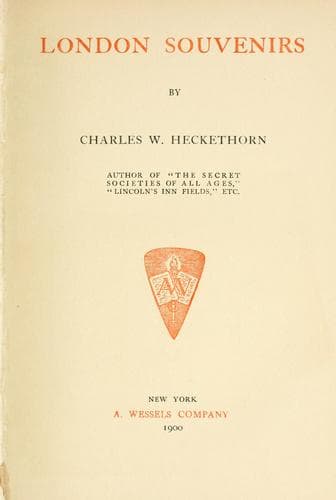
London (England) -- Description and travel; London (England) -- History -- 1800-1950
It was known as Thomas-a-Watering, from St. Thomas, the patron of the
dissolved monastery or hospital of that name in Southwark. The bridge
was the most southern point of the boundary of the Borough of Southwark,
and in ancient days the first halting-place out of London on the road to
Kent. Chaucer’s pilgrims passed it on their way to the shrine of St.
Thomas-a-Becket at Canterbury:
’And forth we riden ...
Unto the watering-place of St. Thomas,
And then our host began his hors arrest.’
Deputations of citizens used to go so far to meet royal or other
distinguished personages who came to visit London. From the end of the
fifteenth century the spot was set apart for executions, and numerous
are the records of criminals who were hanged there until about the
middle of the last century.
In 1690 two very handsome Janus heads—i.e., heads with two faces—were
discovered near St. Thomas-a-Watering. They were found near two ancient
piers of a large gate—Janus was the God of Gates. One was taken up and
set up on a gardener’s door; but the other, being embedded in quicksand,
from which springs flowed out pretty freely, was left. Dr. Woodward,
who founded the Professorship of Geology in the University of Cambridge,
afterwards purchased the head which had been saved, and added it to his
collection of curiosities. At the beginning of this century there was
still a brook running across the Kent Road on the spot mentioned above,
with a bridge over it, and the current from the Peckham and Denmark
hills was at times so strong as to overflow at least two acres of
ground. East of the Mill Street above mentioned there is a spot which
has been rendered famous by Dickens in ’Oliver Twist’—namely, Jacob’s
Island. As the description he gives of it is known to everyone, we need
not here repeat it; it applies, partially only, to the locality now.
It is, or to speak correctly was, a ’Venice of drains.’ But it was not
always so; in the reign of Henry II. the foul, stagnant ditch, which
till recently made an island of this pestilential spot, was a running
stream, supplied with the waters which were brought down in the
Neckinger from the southern hills. On its banks stood the mills of the
monks of St. John and St. Mary, dependencies of the Abbey of Bermondsey,
which were worked by it. In those days the neighbourhood consisted of
blooming gardens and verdant meadows. Close to Jacob’s Island were
Cupid’s Gardens, a kind of Ranelagh on a small scale, but still a very
pleasant place of public entertainment. Tanneries, and many still more
objectionable trades now carried on in the locality, were then undreamt
of.
Public-domain text, read in full here on John Shaqi.
Reviews
Reviews
No reviews yet
Be the first to share your thoughts on this work.
Elsewhere in the archive
Join the Discussion
Join the discussion
Sign in to leave a comment or review.
Sign InorCreate an account