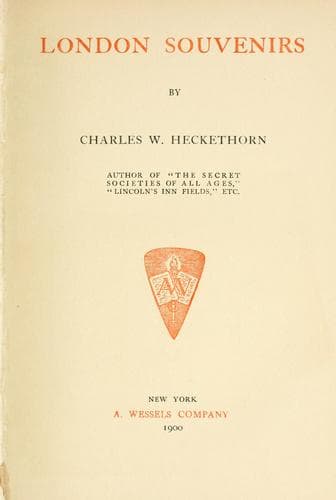
London (England) -- Description and travel; London (England) -- History -- 1800-1950
London in the last century, and even in this, was full of retreats for
criminals. The demolition of West Street, formerly Chick Lane, and of
Field Lane, so recent as to be still fresh in the memory of living
persons, brought many of them to light. The Dog, a low public-house in
Drury Lane, was known as the ’Robbers’ Den’; in fact, the whole street
had a bad reputation, and is even now a disgrace to London. But beside
these private retreats, the rogues and villains of the past had their
public refuges, where even the officers of the law had to leave them
unmolested—the sanctuaries at Westminster, St. John of Jerusalem, St.
Martin’s-le-Grand, Whitefriars and the Mint, and Montague Close in
Southwark, some of which retained their privileges to the middle of the
last century. The name Sanctuary, still given to a certain spot near
Westminster Abbey, commemorates the actual sanctuary formerly existing
in that locality, and the narrow street called Thieving Lane, now
demolished, received that name because thieves, on their way to Gate
House Prison, were taken through it, to prevent their escape into the
sanctuary.
It is said that when rogues fall out honest men come to their own again.
Yes, when their ’own’ is still come-atable, but as a rule it is not;
rogues seldom keep what they gain by trickery—lightly earned, lightly
spent is the rule with them. Rogues are as great fools as are the fools
they cheat, and the fools at heart are rogues too, without the wit of
the rogues. The fool who is done out of his money or other property by
trusting a perfect stranger is so done because he fancies himself more
clever than the cheat, and hopes to beat him. The victim scarcely
deserves any pity, for it is only a case of diamond cut diamond. And
unfortunately, as we intimated above, honest men do not come to their
own again, when rogues fall out, or are detected. The rogue who has
cheated a commercial firm out of goods to the value of thousands of
pounds, which he immediately pawns for half they are worth, rushes off
to a turf tipster or bookie, and though his betting turns out lucky, he
cannot get his winnings from the said bookie, who resists payment on the
plea that the transaction was illegal. The rogues fall out, a lawsuit
is the result, the speculator loses his case, but the firm do not get
their money; that is irretrievably gone. Plenty of such cases happened
hundreds of years ago, and continue to happen to the present day, and
there are various resorts in the City and West End of London where it
might truthfully be written up, _Si sceleratos quœris, circumspice_!
*XVII.*
*BARS AND BARRISTERS.*
Public-domain text, read in full here on John Shaqi.
Reviews
Reviews
No reviews yet
Be the first to share your thoughts on this work.
Elsewhere in the archive
Join the Discussion
Join the discussion
Sign in to leave a comment or review.
Sign InorCreate an account