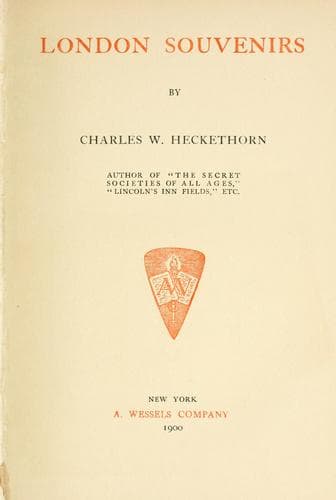
London (England) -- Description and travel; London (England) -- History -- 1800-1950
At her accession to the throne Elizabeth made Hampton Court one of her
favourite residences; it was the most richly furnished, and here she
caused her naval victories over the Spaniards to be worked in fine
tapestries. Here was the scene of her grand festivities, equalling in
splendour those of Henry VIII. Her ordinary dinner was a solemn affair.
Hentzner thus describes it: ’While she was at prayers, we saw her table
set in the following solemn manner: a gentleman entered the room,
bearing a rod, and along with him another, who had a tablecloth, which,
after they had both knelt down three times with the utmost veneration,
he spread upon the table, and, after kneeling again, they both retired.
[Oh, the contemptible flunkey souls of those days!] Then came two
others, one with the rod again, the other with a saltcellar, a plate,
and bread; when they had kneeled, as the others had done, and placed
what was brought upon the table, they then retired with the same
ceremonies performed by the first. At last came an unmarried lady (we
were told she was a Countess), and along with her a married one, bearing
a tasting knife, who, when she had prostrated herself three times in the
most graceful manner, approached the table and rubbed the plates with
bread and salt, with as much awe as if the Queen had been present. When
they had waited there a little while, the yeomen of the guard entered,
bareheaded, clothed in scarlet, with a golden rose upon their backs,
bringing in at each turn a course of twenty-four dishes, served in plate
most of it gilt; these dishes were received by a gentleman in the same
order they were brought and placed upon the table, while the lady taster
gave to each of the guard a mouthful to eat of the particular dish he
had brought, for fear of any poison. During the time that this guard,
which consists of the tallest and stoutest men that can be found in all
England, were bringing dinner, twelve trumpets and two kettle-drums made
the hall ring for half an hour together.’ No wonder that the Maids of
Honour of Queen Elizabeth would, disguised as orange-girls, escape from
the purlieus of the palace, and frequent those of the theatres! The
tidings of the defeat of the Armada arrived on Michaelmas Day, and were
communicated to the Queen whilst she was at dinner at Hampton Court,
partaking of a goose; hence the origin of partaking of that savoury dish
on Michaelmas Day. Such is the tradition; but geese were eaten on that
day and about that time of the year before the Armada was dreamt of;
they are then eaten because then in the finest condition.
Public-domain text, read in full here on John Shaqi.
Reviews
Reviews
No reviews yet
Be the first to share your thoughts on this work.
Elsewhere in the archive
Join the Discussion
Join the discussion
Sign in to leave a comment or review.
Sign InorCreate an account