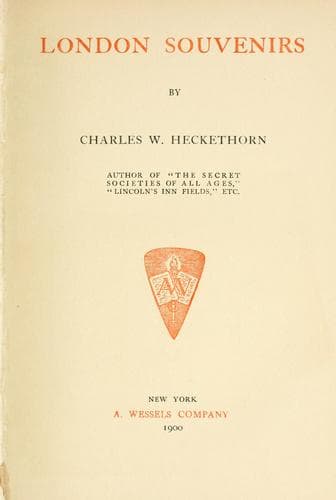
London (England) -- Description and travel; London (England) -- History -- 1800-1950
James II. also occasionally visited Hampton Court, but the palace was
neglected, and did not actually again become a royal residence till the
accession of William III. and Queen Mary. He, as we have already
mentioned on a former occasion, made the palace what it now is by
pulling down the buildings erected by Henry VIII., and covering the site
with the present Fountain Court and the State apartments surrounding it.
According to a drawing by Hollar, showing Hampton Court as furnished by
Henry VIII., the eastern front was really picturesque, and agreed
perfectly with the architectural features of Wolsey’s building. Still,
according to the notions of the seventeenth century, the apartments were
not suitable for a royal residence, especially as William intended to
make it a permanent and not a merely temporary one. Moreover, the King
took a personal pleasure in building and planting and decorating his
residence. He determined to create another Loo on the banks of the
Thames. A wide extent of ground was laid out in formal walks and
parterres; limes, thirty years old, were transplanted from neighbouring
woods to make shady alleys. The new court rose under the direction of
Wren, and with it the grand eastern and southern fronts. It is said
that the King once entertained the idea of erecting an entirely new
palace at the west end of the town of Hampton on an elevation distant
about half a mile from the river Thames, but the design was abandoned
from a consideration of the length of time necessary for such an
undertaking. Horace Walpole informs us that Sir Christopher Wren
submitted another design for the alterations of the ancient palace in a
better taste, which Queen Mary wished to have executed; but she was
overruled. The same authority says: ’This palace of King William seems
erected in emulation of what is intended to imitate the pompous edifices
of the French monarch.’
Unfortunately for William, he found after a time that Hampton Court was
too far from the Houses of Lords and Commons and the public offices, but
being unable to stand the impure air of London, he took up his residence
at Kensington House, which was then quite in the country. But he
frequently visited Hampton Court, and it was there he met with the
accident which caused his death. On February 20, 1702, he was ambling
on a favourite horse named Sorrel through the park. He urged the horse
to strike into a gallop just at a spot where a mole had been at work.
The horse stumbled and went down on his knees; the King fell off and
broke his collar-bone. The bone was set, and the King returned to
Kensington in his coach; but the jolting of the rough roads made it
necessary to reduce the fracture again. He never recovered the double
shock to the system, and fever supervening, he died a few days
subsequently.
Public-domain text, read in full here on John Shaqi.
Reviews
Reviews
No reviews yet
Be the first to share your thoughts on this work.
Elsewhere in the archive
Join the Discussion
Join the discussion
Sign in to leave a comment or review.
Sign InorCreate an account