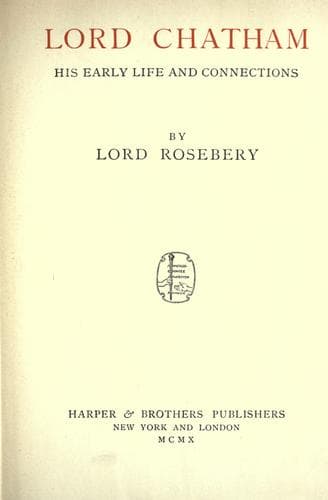
Lord Chatham, His Early Life and ConnectionsRosebery, Archibald Philip Primrose, Earl of
History
Lord Chatham, His Early Life and Connections
Rosebery, Archibald Philip Primrose, Earl of
Pitt, William, Earl of Chatham, 1708-1778
It is said that as a mere boy he gamed and drank and kept a mistress. By
this last scandal the royal family was enabled to present to the world
the unedifying spectacle of grandfather, father, and son simultaneously
living under these immoral conditions; and all three, it is said,
successively with the same woman. But these facts alone would certainly
not have accounted for his father's displeasure. Again, it is narrated
that when his tutor complained of him his mother said that these were
page's tricks. 'Would to God they were, madam,' replied the tutor, 'but
they are rather the tricks of lackeys and knaves.' And tricky Frederick
undoubtedly was from the beginning to the end. But trickiness, though it
was not among the King's faults, and though it would excite his just
contempt, cannot alone have caused the intensity of his hatred.
One if not two of Frederick's escapades were concerned with designs of
marriage. He was discovered on the point of concluding a secret alliance
with Princess Wilhelmine of Prussia, with whom he professed himself in
love, and who afterwards became known to us as Margravine of Bareith; on
another occasion it is said that he was lured by a dowry of 100,000_l._
into a betrothal with Lady Diana Spencer, grand-daughter of Sarah,
Duchess of Marlborough. Both these affairs were interrupted at the last
moment. In both cases the King was irritated by the underhand
proceedings of his son, and by the total lack of a confidence which, as
he probably omitted to remember, he had done nothing to gain. But his
crowning outrage was a monkey-trick, both wanton and barbarous. When he
had at last married a princess of his father's choice, and his wife was
seized with the first pangs of maternity in the King's palace of Hampton
Court, he hurried her off, in her agony and in spite of her entreaties,
to St. James's. At any moment of the journey a catastrophe might have
occurred. What the motive was for this cruel and unmeaning escapade
cannot be guessed, for his own explanations were futile. It was said
that his father suspected him of an intention to foist a spurious child
on his family and that he resented the suspicion. If that were so his
action was exactly suited to confirm it. Whatever his purpose may have
been, the King and Queen, from whom the imminence of the Princess's
situation had been carefully concealed, were naturally and grossly
insulted. The King banished him from his palace and presence, and
forbade the Court to all who should visit him. Nor was there ever an
approach to reconciliation or forgiveness in the fourteen years that the
Prince had yet to live. The King would receive him at Court and would
express the hope that his wife was in good health; that was the extent
of their relations. But though this was the culminating point of his
known misconduct, it would almost seem that there was some more occult
reason which we do not know. We only guess at its existence from the
record of Lord Hardwicke.
Public-domain text, read in full here on John Shaqi.
Reviews
Reviews
No reviews yet
Be the first to share your thoughts on this work.
Elsewhere in the archive
Join the Discussion
Join the discussion
Sign in to leave a comment or review.
Sign InorCreate an account