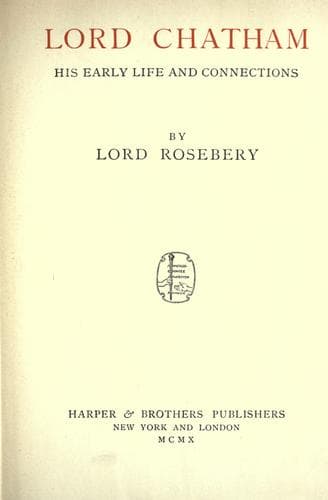
Lord Chatham, His Early Life and ConnectionsRosebery, Archibald Philip Primrose, Earl of
History
Lord Chatham, His Early Life and Connections
Rosebery, Archibald Philip Primrose, Earl of
Pitt, William, Earl of Chatham, 1708-1778
All political malcontents of the slightest importance were sure of a
cordial reception at Leicester House or Kew. There all could warm their
wants and disappointments with the sunshine of royal patronage and the
cheering prospect of a new reign. 'Remember that the King is sixty-one,
and I am thirty-seven,'[108] said Frederick, and this calculation
coloured his whole life. The future was freely discounted and
anticipated in the Prince's circle, so that there, as in the Court of
the Pretender, the faithful adherent might receive some high office to
be enjoyed after the death of the King, but with this substantial
difference: that whereas what James distributed were shadows, the awards
of Frederick required only common good faith and the death of an old man
to make them realities. Bubb for example, the most avid and unabashed of
political harlots, gravely kissed his patron's hand for a Secretaryship
of State, and, according to Walpole, a dukedom, immediately afterwards
nominating his under-secretary, to show the solidity of the arrangement.
Henley, who was afterwards under different circumstances to be
Chancellor, was grievously disappointed to find that Dr. Lee was to have
the seals. And so they snapped and snarled over the spoils, while the
Prince complacently made his appointments, and apportioned the functions
of the future. So far as he was concerned it was all barren enough. His
little projects, his little ambitions, his little ministries, his
political post-obits, were all cut short by the sudden shears of Death.
His councillors and followers were scattered to the winds, and Bubb had
to hasten to make his peace with the powers that be, and to exchange his
contingent Secretaryship of State for an actual Treasurership of the
Navy. The Prince's other post-obits, his debts, were, it would seem,
never paid.[109]
To sum up, with regard to Frederick we have a few certain facts: the
hatred of his parents and sisters, and a singular unanimity of scorn
from his contemporaries. There is not perhaps in existence a single
favourable testimony. We have many portraits, one at Windsor of an
innocent lad in a red coat playing the violoncello with his sisters,
which is pleasant enough; the later ones all stamped with a pretentious
silliness which affirms the verdict of his own day. Then we have the
mysterious intimation of Lord Hardwicke of some deep and sinister cause
for the alienation of his parents. This, however, unsupported and
unexplained, carries us no further, and is merely an excuse for the
unnatural aversion of his family. Beyond that mystery, the word
'fatuous' seems exactly to embody all that we know of this prince; his
appearance, morals, manners, and intellect are all summed up in that
single expression.
Public-domain text, read in full here on John Shaqi.
Reviews
Reviews
No reviews yet
Be the first to share your thoughts on this work.
Elsewhere in the archive
Join the Discussion
Join the discussion
Sign in to leave a comment or review.
Sign InorCreate an account