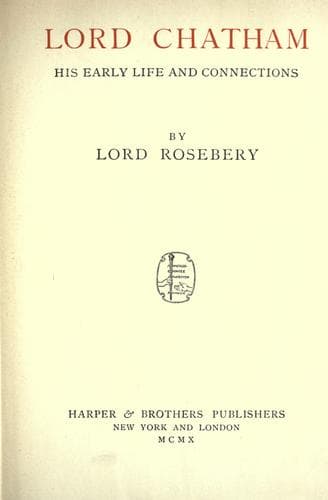
Lord Chatham, His Early Life and ConnectionsRosebery, Archibald Philip Primrose, Earl of
History
Lord Chatham, His Early Life and Connections
Rosebery, Archibald Philip Primrose, Earl of
Pitt, William, Earl of Chatham, 1708-1778
Pitt's nephew, Lord Camelford, asserts as an undoubted fact that the
reputation both of Pitt and of Lyttelton was so considerable before they
entered Parliament, and their political tendencies so notorious, that
Walpole made considerable offers to Thomas Pitt on condition that he did
not brings them in for any of his boroughs. 'William's early abilities,'
writes Lord Camelford, 'induc'd Sir Robert Walpole to offer my father
(Thomas Pitt) any terms not to bring him or his brother-in-law Mr.
Lyttelton into Parliament,' but 'my father preferred their interests to
his own, and laid the foundations, at his own expense, for all his
brother's future fame and greatness.' It is a tradition that Canning,
when in office, kept his eye on promising lads at Eton who might make
eligible followers. One would not, however, have imagined that Walpole
was so much in touch with the rising youth of the country. But if
Camelford may be credited, and there seems no reason to doubt him,
Walpole was prejudiced and on his guard against Pitt before Pitt opened
his mouth; and he may have been hurried into a petulant act by previous
friction unconnected with the speech, which may, moreover, have
contained irritating innuendoes directed against Walpole, which Walpole
alone understood.
The Minister had not been so foolish as to alienate without trying to
secure, and his failure may have exasperated him the more. In later
years Pitt told Shelburne that Sir Robert had offered him the troop
which was afterwards given to Conway, so that had he remained in the
army he would have stood high by seniority alone. This offer, we may
conjecture, was just previous to the overtures to Thomas Pitt. Walpole,
hearing reports of the young officer's conspicuous abilities and of his
hostility to the Government, would try and fix his ambitions in the
army. Failing that, he would try and exclude him from Parliament. And
failing all pacific overtures, he would try different methods. It is
possible, and even probable, that expressions passed during the
negotiations which left a sting. But it now seems clear that no young
private member, without means or influence, ever caused such active
disquietude.
Public-domain text, read in full here on John Shaqi.
Reviews
Reviews
No reviews yet
Be the first to share your thoughts on this work.
Elsewhere in the archive
Join the Discussion
Join the discussion
Sign in to leave a comment or review.
Sign InorCreate an account