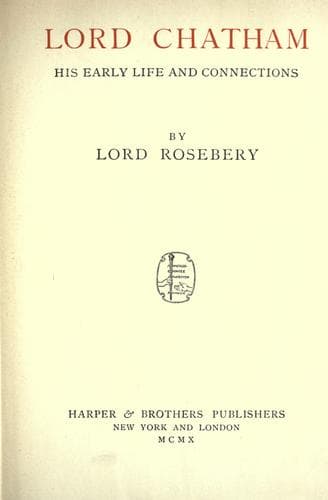
Lord Chatham, His Early Life and ConnectionsRosebery, Archibald Philip Primrose, Earl of
History
Lord Chatham, His Early Life and Connections
Rosebery, Archibald Philip Primrose, Earl of
Pitt, William, Earl of Chatham, 1708-1778
The enthusiasm of the nation was frantic. The heralds, on proceeding to
the city to read the formal declaration, were attended by a great
procession. The Prince of Wales did not disdain to take part in it, or
to pause at Temple Bar to drink a public toast to the war. All the
church bells of the capital were set ringing. The Minister, as he heard
the clang, bitterly remarked that they might ring the bells now, but
that they would soon wring their hands. This is a truth that may be
uttered with justice at the beginning of all hostilities, and in this
case there were many opportunities for wringing hands; for, with the
exception of the truce of Aix-la-Chapelle, Britain was not at peace from
now (1739) till 1763. But Walpole's cynical pun did not embody the
spirit which gives confidence to a nation, or in which a great Minister
would begin a just or necessary war. Walpole was, no doubt, convinced
that this one was neither just nor necessary. Moreover, he hated all
war as a needless complication which deranged finance and held out
prospects and opportunities for a Pretender. He knew, too, that he was a
Minister of peace, and that he was not likely to shine in war. He had
indeed been Secretary at War, but then he had the guarantee of a
Marlborough in the field; his function had been to serve and supply a
supreme captain. But there was nothing now to give him the same
confidence. He felt, he knew that he was out of place as a director of
wars. Close to him, unsuspected as yet, was the most successful War
Minister that this country has ever seen. For on the benches over
against him sate Pitt, who was to revel in warfare and find his true
vocation in directing it; but his time was not come. Afterwards, when it
had arrived, he was to repent and recant his opposition on this
occasion, and pay homage to Walpole. None, indeed, of the leaders in
opposition to Walpole attempted afterwards to justify their conduct in
this business.
That Minister meanwhile moodily prepared to carry out the wishes of the
country, and no doubt excused himself for his humiliating compliance by
the thought that if he did not some one else would, with less economy
and more danger to the State. He is said to have tendered his
resignation, but even were this true it could only be, in view of the
King's relations to himself and the Opposition, a matter of form. He
uttered his own self-condemnation: 'I dare not do what is right.'
Public-domain text, read in full here on John Shaqi.
Reviews
Reviews
No reviews yet
Be the first to share your thoughts on this work.
Elsewhere in the archive
Join the Discussion
Join the discussion
Sign in to leave a comment or review.
Sign InorCreate an account