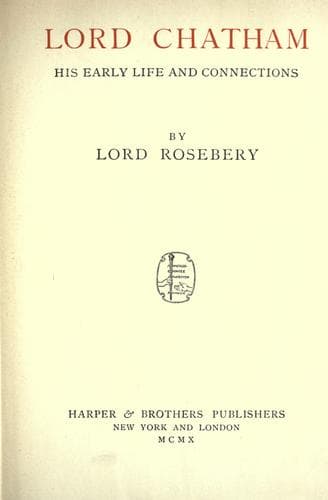
Lord Chatham, His Early Life and ConnectionsRosebery, Archibald Philip Primrose, Earl of
History
Lord Chatham, His Early Life and Connections
Rosebery, Archibald Philip Primrose, Earl of
Pitt, William, Earl of Chatham, 1708-1778
Pulteney was the enemy, or its chief; for he led the Opposition, and
guided the Court of the Heir Apparent, as he had that of the father when
Prince of Wales, though then without fruit and result. He was also the
idol of the nation. For long years he had made the people believe that
Walpole was a Goliath of corruption, and that he was the incorruptible
David. Moreover, his vast wealth, his ability, his eloquence, and his
social qualities gave him a personal ascendancy apart from his political
position. 'He was, by all accounts,' writes Shelburne, 'the greatest
House of Commons orator that had ever appeared,'[129] surpassing even
the legendary reputation of Bolingbroke; he was also a scholar, a wit,
and a potent pamphleteer. In conversation he excelled; when the wits
were gathered at Stowe, the pre-eminence of Pulteney was
acknowledged.[130] At this moment he was supreme, 'in the greatest point
of view,' writes Chesterfield, 'that I ever saw any subject in ... the
arbiter between the Crown and the people; the former imploring his
protection, the latter his support;' 'possessing,' says Glover, 'a
degree of popularity and power which no subject before him was ever
possessed of.' All eyes were raised to him with expectant adoration as
he stood on this pinnacle, and as they gazed they saw him slowly totter,
and then fall headlong. For the two Ministers had succeeded in
compromising him. He refused, indeed, amnesty for Walpole or office for
himself; but adulterated these refusals by watering his expressions of
hostility to the Minister, and by asking on his own behalf for an
earldom and a seat in the Cabinet. When his followers found that he and
Carteret were engaged in secret negotiation with Ministers, their
indignation was unbounded. They held a public meeting to disown him. His
popularity disappeared in an instant and for ever. He afterwards averred
that he had lost his head, that there was no comprehending or describing
the confusion that prevailed, and that he was obliged to go out of town
for three or four days to keep his senses. This is not impossible or
even improbable. A political crisis bursts like a tornado, and
bewilders the strongest characters. Both rare and happy are the men who
can on such occasions take counsel with themselves, and meet the storm
with presence of mind. Pulteney had, perhaps, become enervated with a
long period of merely negative opposition. Glover also asserts that his
hand was forced by Lyttelton who was secretly offering terms to Walpole,
and that these, though tendered by the Prince of Wales's Secretary,
Walpole treated with disdain. Glover was an ill-conditioned wasp, and
his story refutes itself. For the one person whom Walpole was anxious to
gain was Frederick, even offering to add 50,000_l._ to his income. That
he should then have spurned an overture from the Prince's right-hand man
is out of the question; he would have met it more than half-way.
Public-domain text, read in full here on John Shaqi.
Reviews
Reviews
No reviews yet
Be the first to share your thoughts on this work.
Elsewhere in the archive
Join the Discussion
Join the discussion
Sign in to leave a comment or review.
Sign InorCreate an account