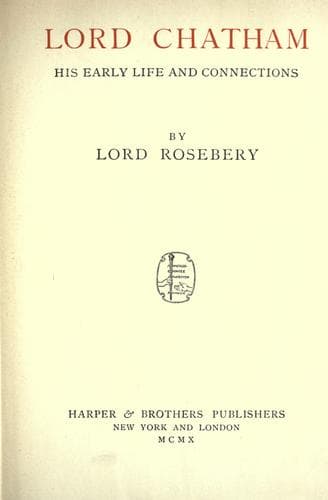
Lord Chatham, His Early Life and ConnectionsRosebery, Archibald Philip Primrose, Earl of
History
Lord Chatham, His Early Life and Connections
Rosebery, Archibald Philip Primrose, Earl of
Pitt, William, Earl of Chatham, 1708-1778
the arts and equipment of the parliamentary army, heedless of the fact
that parliamentary support is the vital necessity of a British minister.
Disdainful of public opinion or party connections, he attempted to play
the great game in Europe with no resource but his own abilities and the
confidence of his sovereign, whose antipathy to France he shared, and
whose policy and prejudices he could discuss in the King's native
language. And yet over the bottle, which he loved at least as much as
literature or politics, he would laugh at the whole business and the men
with whom he was engaged. 'What is it to me,' he would say, 'who is a
judge or who is a bishop? It is my business to make Kings and Emperors';
and he would have to be reminded that those who wanted offices or
honours would follow and support those who did deal in those
commodities. One can hear his jolly laugh. His policy he embodied in one
striking sentence: 'I want to instil a nobler ambition into you, to make
you knock the heads of the Kings of Europe together, and jumble
something out of it which may be of service to this country.' As a
matter of fact though he did undoubtedly knock together the heads of
some kings, no material advantage resulted to the country. He was,
however, a patriot, a single-minded, able, jovial, reckless patriot, but
out of touch with the politicians, unsuited to parliamentary government,
and so almost ineffectual. And thus we see him at his best on his
deathbed, where he quotes to the under-secretary who brought him the
Treaty of Paris for approval the speech of Sarpedon with melancholy
emphasis. 'Friend of my soul, were we to escape from this war, and then
live for ever without old age or death, I should not fight myself among
the foremost, nor would I send thee into the glorifying battle; but a
thousand fates of death stand over us, which mortal man may not flee
from and avoid; then let us on.' These last words he repeated with calm
and determined resignation, and after a pause of some minutes desired
the preliminary articles of the Peace of Paris to be read to him. After
hearing these at length he desired that, to use own words, the
approbation of a dying statesman might be declared to the most glorious
war and the most honourable peace that this nation ever saw.[134] The
news of his extremity had reached Chesterfield. 'When he dies,' wrote
this shrewdest judge and observer of mankind in England, who had in his
factious days called Carteret 'a wild and drunken minister,'[135] 'the
ablest head in England dies too, take it for all in all.'[136]
Public-domain text, read in full here on John Shaqi.
Reviews
Reviews
No reviews yet
Be the first to share your thoughts on this work.
Elsewhere in the archive
Join the Discussion
Join the discussion
Sign in to leave a comment or review.
Sign InorCreate an account